Function
Lysin (Lys) is a protein which cleaves cell walls. Egg Lysin, a protein from abalone sperm, creates a hole in the envelope of the egg, permitting the sperm to pass through the envelope and fuse with the egg.
Structural highlights
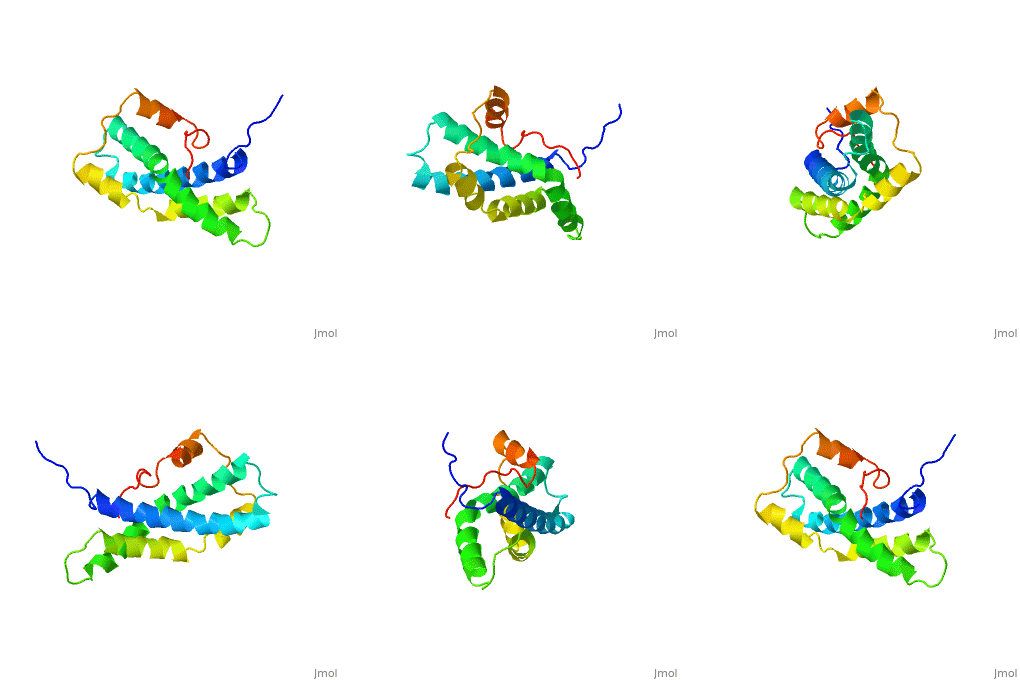
The structure of lysin, refined at 1.9 angstroms resolution, reveals an alpha-helical, amphipathic molecule. . you can see the alpha helixes in pink. exhibits three features: two tracks of basic residues that span the length of the molecule, a solvent-exposed cluster of ,(in green) and an extended amino-terminal hypervariable domain that is species-specific. The structure suggests possible mechanisms of action[1].
3D structure of lysin
Updated on 22-October-2019
1lis, 1lyn, 2lis, 2lyn, 3lyn, 5ii7, 5ii8, 5ii9 – aLys - abalone
5utg – aLys (mutant)
5iia, 5iib, 5mr3 – aLys + vitelline envelope sperm lysin receptor
1nkl – NK-Lys – pig – NMR
4cvd – Lys – bacteriophage CP-7
6ilu – Lys – bacteriophage PBC5
1h09 – bLys – bacteriophage CP-1
1oba – bLys + choline
2ixu – bLys + peptidoglycan analog
2ixv, 2j8f, 2j8g – bLys (mutant) + peptidoglycan analog
2mk5 – GH15Lys residues 368-495 – phage GH15 – NMR
4olk – GH15Lys CHAP domain residues 1-165
4ols – GH15Lys amidase domain residues 165-403