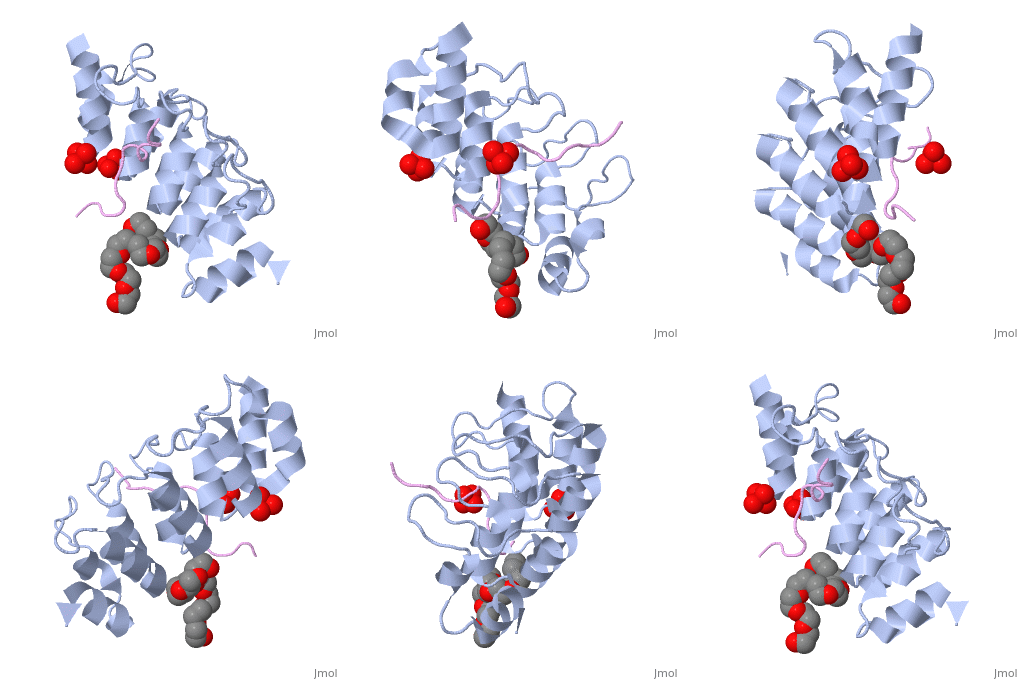
| Structural highlights
Disease
3BP2_HUMAN Defects in SH3BP2 are the cause of cherubism (CRBM) [MIM:118400. CRBM is an autosomal dominant inherited syndrome characterized by excessive bone degradation of the upper and lower jaws, which often begins around three years of age. It is followed by development of fibrous tissue masses, which causes a characteristic facial swelling.[1] [2] [3]
Function
3BP2_HUMAN Binds differentially to the SH3 domains of certain proteins of signal transduction pathways. Binds to phosphatidylinositols; linking the hemopoietic tyrosine kinase fes to the cytoplasmic membrane in a phosphorylation dependent mechanism.
Publication Abstract from PubMed
The poly(ADP-ribose)polymerases Tankyrase 1/2 (TNKS/TNKS2) catalyze the covalent linkage of ADP-ribose polymer chains onto target proteins, regulating their ubiquitylation, stability, and function. Dysregulation of substrate recognition by Tankyrases underlies the human disease cherubism. Tankyrases recruit specific motifs (often called RxxPDG "hexapeptides") in their substrates via an N-terminal region of ankyrin repeats. These ankyrin repeats form five domains termed ankyrin repeat clusters (ARCs), each predicted to bind substrate. Here we report crystal structures of a representative ARC of TNKS2 bound to targeting peptides from six substrates. Using a solution-based peptide library screen, we derive a rule-based consensus for Tankyrase substrates common to four functionally conserved ARCs. This 8-residue consensus allows us to rationalize all known Tankyrase substrates and explains the basis for cherubism-causing mutations in the Tankyrase substrate 3BP2. Structural and sequence information allows us to also predict and validate other Tankyrase targets, including Disc1, Striatin, Fat4, RAD54, BCR, and MERIT40.
Structural basis and sequence rules for substrate recognition by tankyrase explain the basis for cherubism disease.,Guettler S, Larose J, Petsalaki E, Gish G, Scotter A, Pawson T, Rottapel R, Sicheri F Cell. 2011 Dec 9;147(6):1340-54. PMID:22153077[4]
From MEDLINE®/PubMed®, a database of the U.S. National Library of Medicine.
See Also
References
- ↑ Ueki Y, Tiziani V, Santanna C, Fukai N, Maulik C, Garfinkle J, Ninomiya C, doAmaral C, Peters H, Habal M, Rhee-Morris L, Doss JB, Kreiborg S, Olsen BR, Reichenberger E. Mutations in the gene encoding c-Abl-binding protein SH3BP2 cause cherubism. Nat Genet. 2001 Jun;28(2):125-6. PMID:11381256 doi:10.1038/88832
- ↑ Lo B, Faiyaz-Ul-Haque M, Kennedy S, Aviv R, Tsui LC, Teebi AS. Novel mutation in the gene encoding c-Abl-binding protein SH3BP2 causes cherubism. Am J Med Genet A. 2003 Aug 15;121A(1):37-40. PMID:12900899 doi:http://dx.doi.org/10.1002/ajmg.a.20226
- ↑ Imai Y, Kanno K, Moriya T, Kayano S, Seino H, Matsubara Y, Yamada A. A missense mutation in the SH3BP2 gene on chromosome 4p16.3 found in a case of nonfamilial cherubism. Cleft Palate Craniofac J. 2003 Nov;40(6):632-8. PMID:14577811
- ↑ Guettler S, Larose J, Petsalaki E, Gish G, Scotter A, Pawson T, Rottapel R, Sicheri F. Structural basis and sequence rules for substrate recognition by tankyrase explain the basis for cherubism disease. Cell. 2011 Dec 9;147(6):1340-54. PMID:22153077 doi:10.1016/j.cell.2011.10.046
|