Sandbox Home

From Proteopedia

Revision as of 16:06, 30 September 2025 by Joel L. Sussman (Talk | contribs)
Jump to: navigation, search
       ISSN 2310-6301
     
       As life is more than 2D, Proteopedia helps to bridge the gap between 3D structure & function of biomacromolecules
     
     
       Proteopedia presents this information in a user-friendly way as a collaborative & free 3D-encyclopedia of proteins & other biomolecules.
     
Selected Research Pages In Journals Education
About this image
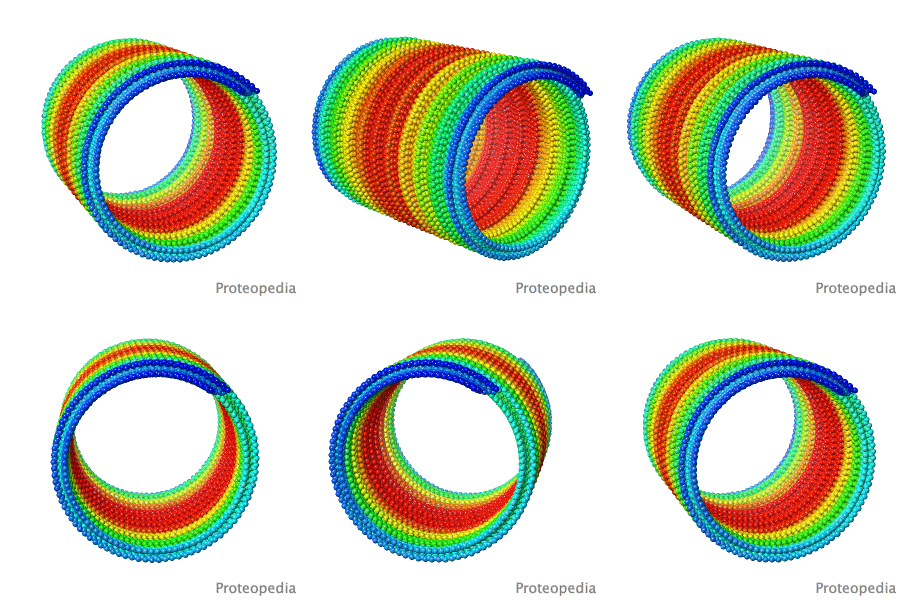
Bacteria float with nano-balloons.

ST Huber, D Terwiel, WH Evers, D Maresca, AJ Jakobi. Preprint 2022 doi: 10.1101/2022.05.08.489936
Many kinds of bacteria and archaea control their buoyancy to move to optimal positions in liquid environments. They do this by making nano-compartments called "gas vesicles", long "pipes" with closed ends filled with gases. In 2022, gas vesicle structure was solved, revealing self-assembling thin-walled cylinders of remarkable strength with gas-permeable pores and water-repelling (hydrophobic) interiors. Building on this structural knowledge, gas vesicles are being engineered to serve as biosensors that report via ultrasound.

>>> Visit I3DC Interactive Visualizations >>>

About this image
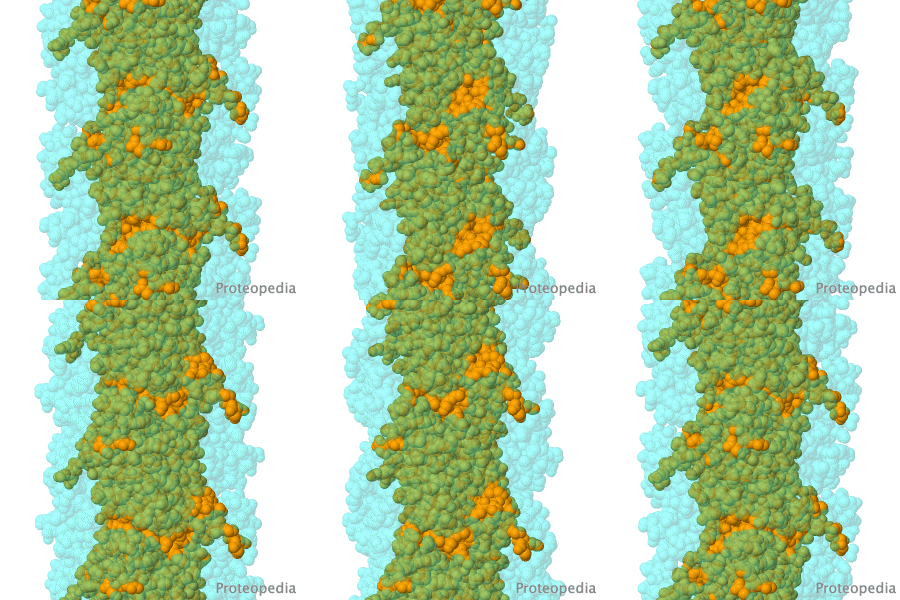
Geobacter pili: surprising function.

Y Gu, V Srikanth, AI Salazar-Morales, R Jain, JP O'Brien, SM Yi, RK Soni, FA Samatey, SE Yalcin, NS Malvankar. Nature 2021 doi: 10.1038/s41586-021-03857-w
Geobacter pili were long thought to be electrically conductive protein nanowires composed of PilA-N. Nanowires are crucial to the energy metabolism of bacteria flourishing in oxygen-deprived environments. To everyone's surprise, in 2019, the long-studied nanowires were found to be linear polymers of multi-heme cytochromes, not pili. The first cryo-EM structure of pili (2021) reveals a filament made of dimers of PilA-N and PilA-C, shown. Electrical conductivity of pili is much lower than that of cytochrome nanowires. Evidence suggests that PilA-NC filaments are periplasmic pseudopili crucial for exporting cytochrome nanowires onto the cell surface, rather than the pili serving as nanowires themselves.

>>> Visit I3DC Interactive Visualizations >>>

About this image
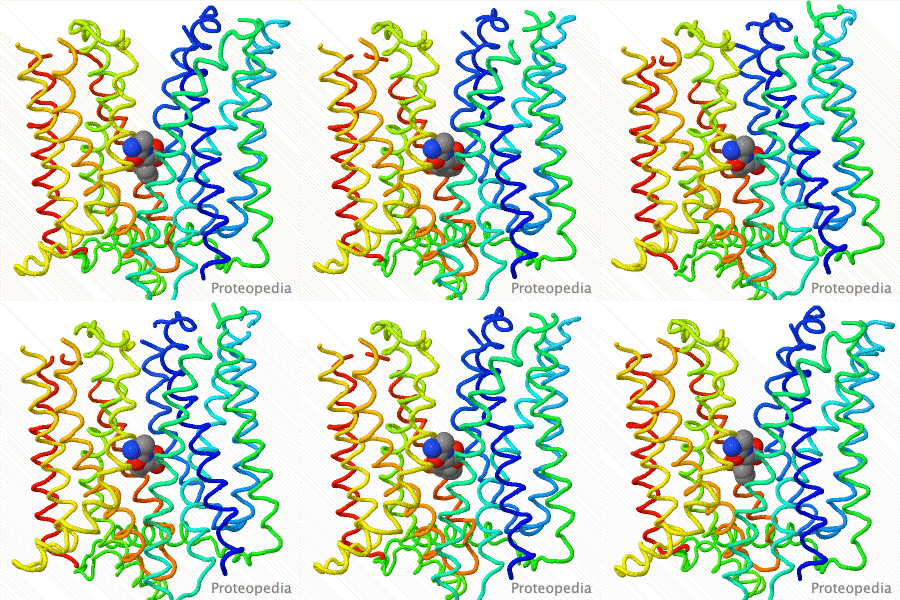
Touch-Sensitive Channel

Touching stretches cell membranes, opening mechanosensitive ion channels, leading to sensation by the nervous system. Pictured is the transmembrane region of a similar channel in bacteria. When closed, the narrow opening is lined by hydrophobic amino acid sidechains, making it non-conductive to ions.

>>> See more animations and explanation >>>

About Contact Hot News Table of Contents Structure Index Help
Personal tools