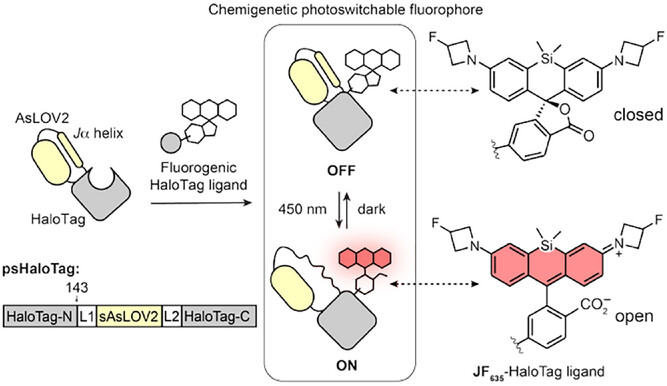
The Photoswitchable Halo Tag (psHaloTag) is a unique chemigenetic system designed to provide reversible, light-controlled fluorescence tunable through both genetic and synthetic modifications, with promising applications for dynamic imaging in biological microscopy [1]. psHaloTag addresses a major gap in the availability of reliable, reversible systems suitable for live-cell imaging. Many current systems are limited in tracking long-term, cyclical processes or in refreshing the pool of observable molecules. psHaloTag combines the genetically encoded HaloTag protein with the light-sensing sAsLOV2 domain. When illuminated with 450 nm light, psHaloTag undergoes a reversible change that activates a bound rhodamine dye ligand, resulting in a significant increase in fluorescence. This strong, multiple-cycle reporter overcomes the limitations of irreversible systems. It is an important tool for achieving precise spatiotemporal control in demanding applications such as live-cell Super-Resolution Microscopy (SMLM), where many established photosensitive probes cannot be reactivated.
Function
The psHaloTag works as an allosteric photoswitch.
- Protein Scaffold: An engineered HaloTag protein with the light-sensing sAsLOV2 domain.
- Ligand: Binds to a fluorogenic rhodamine dye (e.g., JF635-HTL).
- Light ON (450 nm): Light activates the sAsLOV2 domain using FMN cofactor, causing a conformational change (Jα helix unfolding).
- Fluorescence ON: This change forces the bound dye into its fluorescent state.
- Light OFF (Dark): The protein structure relaxes back to its original shape, shifting the dye back to its non-fluorescent state.
Mechanism
Structural highlights
Relevance
This is a sample scene created with SAT to by Group, and another to make of the protein. You can make your own scenes on SAT starting from scratch or loading and editing one of these sample scenes.

