This old version of Proteopedia is provided for student assignments while the new version is undergoing repairs. Content and edits done in this old version of Proteopedia after March 1, 2026 will eventually be lost when it is retired in about June of 2026.
Apply for new accounts at the new Proteopedia. Your logins will work in both the old and new versions.
2gr9
From Proteopedia
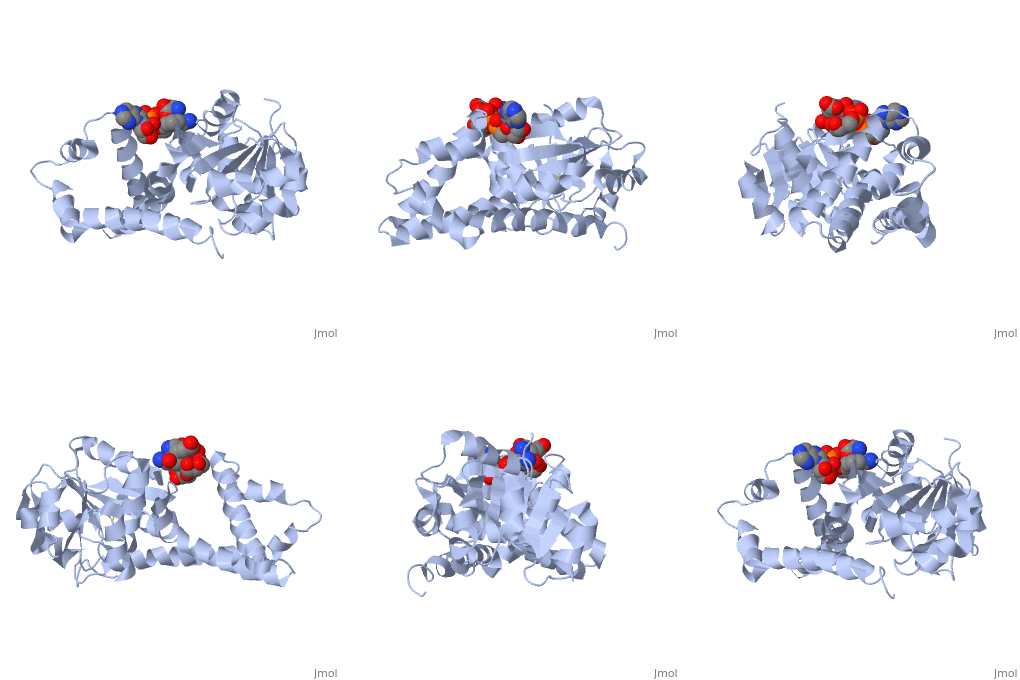
Crystal structure of P5CR complexed with NADH
Structural highlights
DiseaseP5CR1_HUMAN Defects in PYCR1 are the cause of cutis laxa autosomal recessive type 2B (ARCL2B) [MIM:612940. A multisystem disorder characterized by the appearance of premature aging, wrinkled and lax skin with reduced elasticity, joint laxity, craniofacial dysmorphic features, intrauterine growth retardation with some degree of postnatal growth deficiency, and developmental delay.[1] [2] Defects in PYCR1 are the cause of cutis laxa, autosomal recessive, type 3B (ARCL3B) [MIM:614438. ARCL3B is a disorder characterized by an aged appearance with distinctive facial features, sparse hair, ophthalmologic abnormalities, intrauterine growth retardation, and cutis laxa.[3] [4] FunctionP5CR1_HUMAN Housekeeping enzyme that catalyzes the last step in proline biosynthesis. Can utilize both NAD and NADP, but has higher affinity for NAD. Involved in the cellular response to oxidative stress.[5] [6] Evolutionary Conservation Check, as determined by ConSurfDB. You may read the explanation of the method and the full data available from ConSurf. Publication Abstract from PubMedPyrroline-5-carboxylate reductase (P5CR) is a universal housekeeping enzyme that catalyzes the reduction of Delta(1)-pyrroline-5-carboxylate (P5C) to proline using NAD(P)H as the cofactor. The enzymatic cycle between P5C and proline is very important for the regulation of amino acid metabolism, intracellular redox potential, and apoptosis. Here, we present the 2.8 Angstroms resolution structure of the P5CR apo enzyme, its 3.1 Angstroms resolution ternary complex with NAD(P)H and substrate-analog. The refined structures demonstrate a decameric architecture with five homodimer subunits and ten catalytic sites arranged around a peripheral circular groove. Mutagenesis and kinetic studies reveal the pivotal roles of the dinucleotide-binding Rossmann motif and residue Glu221 in the human enzyme. Human P5CR is thermostable and the crystals were grown at 37 degrees C. The enzyme is implicated in oxidation of the anti-tumor drug thioproline. Crystal structure of human pyrroline-5-carboxylate reductase.,Meng Z, Lou Z, Liu Z, Li M, Zhao X, Bartlam M, Rao Z J Mol Biol. 2006 Jun 23;359(5):1364-77. Epub 2006 May 11. PMID:16730026[7] From MEDLINE®/PubMed®, a database of the U.S. National Library of Medicine. See AlsoReferences
| ||||||||||||||||||||
Categories: Homo sapiens | Large Structures | Liu Z | Lou Z | Meng Z | Rao Z
