This old version of Proteopedia is provided for student assignments while the new version is undergoing repairs. Content and edits done in this old version of Proteopedia after March 1, 2026 will eventually be lost when it is retired in about June of 2026.
Apply for new accounts at the new Proteopedia. Your logins will work in both the old and new versions.
1w06
From Proteopedia
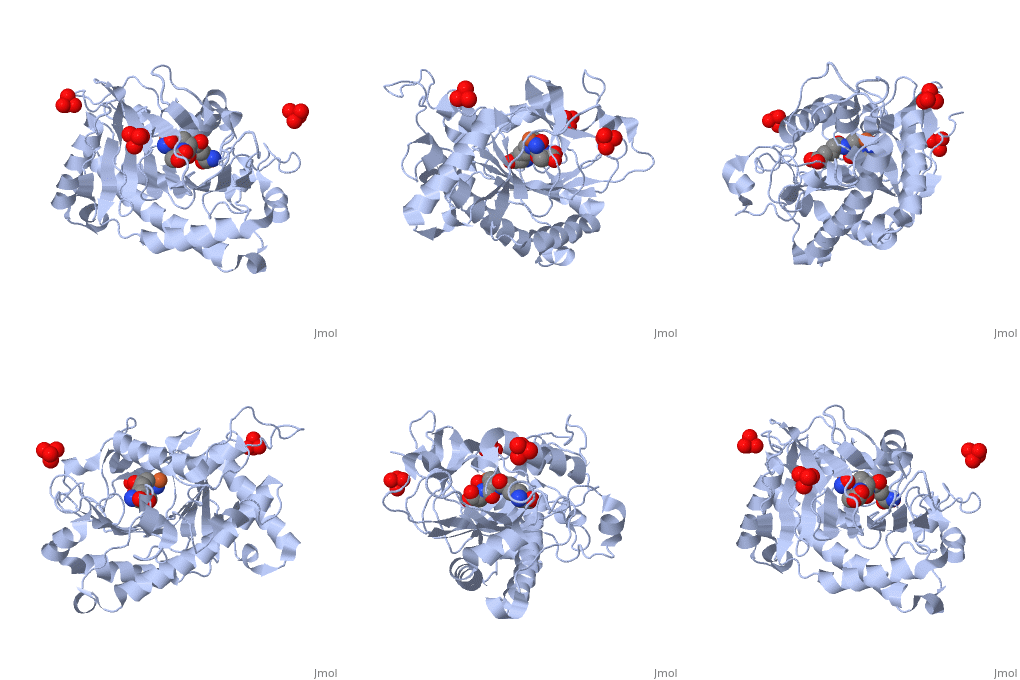
Isopenicillin N Synthase Aminoadipoyl-Cysteinyl-Alanine-Fe NO Complex
Structural highlights
FunctionIPNA_EMENI Isopenicillin N synthase; part of the gene cluster that mediates the biosynthesis of penicillin, the world's most important antibiotic (PubMed:3319778, PubMed:11755401). IpnA catalyzes the cyclization of the tripeptide N-[(5S)-5-amino-5-carboxypentanoyl]-L-cysteinyl-D-valine (LLD-ACV or ACV) to form isopenicillin N (IPN) that contains the beta-lactam nucleus (PubMed:3319778, PubMed:11755401, PubMed:28703303). The penicillin biosynthesis occurs via 3 enzymatic steps, the first corresponding to the production of the tripeptide N-[(5S)-5-amino-5-carboxypentanoyl]-L-cysteinyl-D-valine (LLD-ACV or ACV) by the NRPS acvA. The tripeptide ACV is then cyclized to isopenicillin N (IPN) by the isopenicillin N synthase ipnA that forms the beta-lactam nucleus. Finally, the alpha-aminoadipyl side chain is exchanged for phenylacetic acid by the isopenicillin N acyltransferase penDE to yield penicillin in the peroxisomal matrix (By similarity).[UniProtKB:P08703][1] [2] [3] Evolutionary Conservation Check, as determined by ConSurfDB. You may read the explanation of the method and the full data available from ConSurf. Publication Abstract from PubMedIsopenicillin N synthase (IPNS), a non-heme iron(II)-dependent oxidase, catalyzes conversion of the tripeptide delta-(l-alpha-aminoadipoyl)-l-cysteinyl-d-valine (ACV) to bicyclic isopenicillin N (IPN), concomitant with the reduction of dioxygen to two molecules of water. Incubation of the "truncated"substrate analogues delta-(l-alpha-aminoadipoyl)-l-cysteinyl-glycine (ACG) and delta-(l-alpha-aminoadipoyl)-l-cysteinyl-d-alanine (ACA) with IPNS has previously been shown to afford acyclic products, in which the substrate cysteinyl residue has undergone a two-electron oxidation. We report X-ray crystal structures for the anaerobic IPNS/Fe(II)/ACG and IPNS/Fe(II)/ACA complexes, both in the absence and presence of the dioxygen analogue nitric oxide. The overall protein structures are very similar to those of the corresponding IPNS/Fe(II)/ACV complexes; however, significant differences are apparent in the vicinity of the active site iron. The structure of the IPNS/Fe(II)/ACG complex reveals that the C-terminal carboxylate of this substrate is oriented toward the active site iron atom, apparently hydrogen-bonded to an additional water ligand at the metal; this is a different binding mode to that observed in the IPNS/Fe(II)/ACV complex. ACA binds to the metal in a manner that is intermediate between those observed for ACV and ACG. The addition of NO to these complexes initiates conformational changes such that both the IPNS/Fe(II)/ACG/NO and IPNS/Fe(II)/ACA/NO structures closely resemble the IPNS/Fe(II)/ACV/NO complex. These results further demonstrate the feasibility of metal-centered rearrangements in catalysis by non-heme iron enzymes and provide insight into the delicate balance between hydrophilic-hydrophobic interactions and steric effects in the IPNS active site. Structural studies on the reaction of isopenicillin N synthase with the truncated substrate analogues delta-(L-alpha-aminoadipoyl)-L-cysteinyl-glycine and delta-(L-alpha-aminoadipoyl)-L-cysteinyl-D-alanine.,Long AJ, Clifton IJ, Roach PL, Baldwin JE, Rutledge PJ, Schofield CJ Biochemistry. 2005 May 3;44(17):6619-28. PMID:15850395[4] From MEDLINE®/PubMed®, a database of the U.S. National Library of Medicine. See AlsoReferences
| ||||||||||||||||||||