This old version of Proteopedia is provided for student assignments while the new version is undergoing repairs. Content and edits done in this old version of Proteopedia after March 1, 2026 will eventually be lost when it is retired in about June of 2026.
Apply for new accounts at the new Proteopedia. Your logins will work in both the old and new versions.
3gfp
From Proteopedia
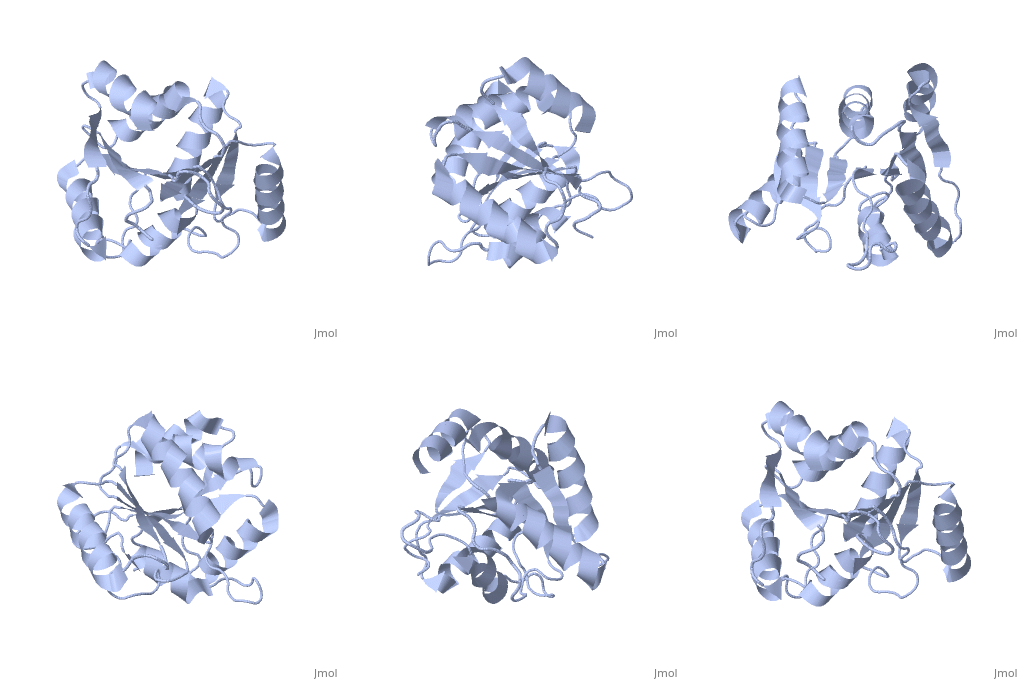
Structure of the C-terminal domain of the DEAD-box protein Dbp5
Structural highlights
Function[DBP5_YEAST] ATP-dependent RNA helicase associated with the nuclear pore complex and essential for mRNA export from the nucleus. May participate in a terminal step of mRNA export through the removal of proteins that accompany mRNA through the nucleopore complex. Contributes to the blocking of bulk poly(A)+ mRNA export in ethanol-stressed cells. May also be involved in early transcription.[1] [2] [3] [4] [5] [6] [7] [8] [9] [10] [11] Evolutionary Conservation Check, as determined by ConSurfDB. You may read the explanation of the method and the full data available from ConSurf. Publication Abstract from PubMedThe DExD/H-box RNA-dependent ATPase Dbp5 plays an essential role in the nuclear export of mRNA. Dbp5 localizes to the nuclear pore complex, where its ATPase activity is stimulated by Gle1 and its coactivator inositol hexakisphosphate. Here, we present the crystal structure of the C-terminal domain of Dbp5, refined to 1.8 A. The structure reveals a RecA-like fold that contains two defining characteristics not present in other structurally characterized DExD/H-box proteins: a C-terminal alpha-helix and a loop connecting beta5 and alpha4, both of which are composed of conserved and unique elements in the Dbp5 primary sequence. Using structure-guided mutagenesis, we have identified several charged surface residues that, when mutated, weaken the binding of Gle1 and inhibit the ability of Gle1 to stimulate Dbp5's ATPase activity. In vivo analysis of the same mutations reveals that those mutants displaying the weakest ATPase stimulation in vitro are also unable to support yeast growth. Analysis of the correlation between the in vitro and in vivo data indicates that a threshold level of Dbp5 ATPase activity is required for cellular mRNA export that is not met by the unstimulated enzyme, suggesting a possible mechanism by which Dbp5's activity can be modulated to regulate mRNA export. Structure of the C-terminus of the mRNA export factor Dbp5 reveals the interaction surface for the ATPase activator Gle1.,Dossani ZY, Weirich CS, Erzberger JP, Berger JM, Weis K Proc Natl Acad Sci U S A. 2009 Sep 22;106(38):16251-6. Epub 2009 Sep 2. PMID:19805289[12] From MEDLINE®/PubMed®, a database of the U.S. National Library of Medicine. See AlsoReferences
| ||||||||||||||||||||
Categories: Atcc 18824 | Large Structures | Berger, J M | Dossani, Z Y | Erzberger, J P | Weirich, C S | Weis, K | Atp-binding | Atpase | Helicase | Hydrolase | Membrane | Mrna export | Mrna transport | Nuclear pore complex | Nucleotide-binding | Nucleus | Phosphoprotein | Protein transport | Reca-fold | Rna-binding | Translocation | Transport
