SsdA is a single stranded DNA (ssDNA) cytidine deaminase toxin produced by Pseudomonas syringae. It belongs to the bacterial deaminase toxin family-2 (BaDTF2), which is a new class of interbacterial Type VI secretion (T6SS) effectors. Unlike many eukaryotic, SsdA has relaxed requirements, making it a very broad-specificity ssDNA mutator.
Function
SsdA changes cytosine to uracil only in ssDNA , showing no significant activity in dsDNA even in presence of excess complementary strands. It effectively edits cytosines regardless of the preceding base, creating mutations that can inhibit growth of competing bacteria and provide a growth advantage to the host strain. Its cytotoxic effect can be neutralised by its anti-toxin SsdAI, which blocks the DNA-binding cleft by mimicking the substrate.
Structure and Mechanism
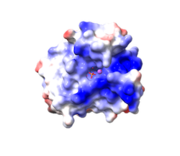
The dark blue region represents the highly positive groove
The structure of the SsdA-ssDNA complex was determined by molecular replacement phasing and refined to 1.94-Å resolution. As with the deaminase superfamily, SsdA at its core is also made up of two α-helices and a layer of β-sheet. The catalytically important Zinc ion is coordinated by a conserved triad motif comprising of His346, Cys367 and Cys370. Uniquely, SsdA contains a rare β-amino acid isoaspartate (isoAsp294), which improves protein stability and optimizes ssDNA binding.
The ssDNA binds to a deep positively charged groove between two protruding grooves. The groove is narrowest between Val288 and Tyr334. The resiudes extend inward to partially block the opening above the active site. Aromatic residues His332, Tyr334, Tyr342, and Phe343 create a stabilising scaffold that shapes and supports the sharply bent ssDNA as it nears the catalytic center. In the active site, the Thr290 engages the target 2'-deoxycytidie. Nearby residues Lys289 and Ser300 stabilize the downstream DNA segment.
Relevance
As a T6SS toxin, SsdA plays a role in bacterial competition and may contribute to the evolution of antibiotic resistance in surviving target populations. Beyond its natural roles, the broad, sequence-independent deaminase activity makes SsdA a promising tool for genome engineering.
Conclusion
SsdA stands out as a unique and functionally flexible DNA deaminase toxin. Its ability to bend ssDNA, flip a target cytosine, and work without strict sequence preference distinguishes it from other BaDTF family members.
This page was made as a part of the BI3323-Aug2025 Structural Biology course, by Saachi Sirola (20231212).

