This old version of Proteopedia is provided for student assignments while the new version is undergoing repairs. Content and edits done in this old version of Proteopedia after March 1, 2026 will eventually be lost when it is retired in about June of 2026.
Apply for new accounts at the new Proteopedia. Your logins will work in both the old and new versions.
Flagellar protein
From Proteopedia
(Difference between revisions)
| (4 intermediate revisions not shown.) | |||
| Line 1: | Line 1: | ||
<StructureSection load='1io1' size='340' side='right' caption='Flagellin major fragment of ''Salmonella typhimurium'' (PDB code [[1io1]])' scene=''> | <StructureSection load='1io1' size='340' side='right' caption='Flagellin major fragment of ''Salmonella typhimurium'' (PDB code [[1io1]])' scene=''> | ||
| + | __TOC__ | ||
| + | |||
| + | ==Function== | ||
| + | |||
[[Image:Flagellum1 800px.jpg|left|thumb|The bacterial flagellum consists of a filament, a universal joint (hook), and a motor (basal body).|200px]]<br /> | [[Image:Flagellum1 800px.jpg|left|thumb|The bacterial flagellum consists of a filament, a universal joint (hook), and a motor (basal body).|200px]]<br /> | ||
Flagella (singular: flagellum) enable bacteria to swim towards sources of nutrition, and away from sources of toxins. Such directed motility is termed ''[http://en.wikipedia.org/wiki/Chemotaxis chemotaxis]''. Rapid swimming helps [http://en.wikipedia.org/wiki/Bdellovibrio Bdellovibrio] penetrate and parasitize their host bacteria, but flagella are not always essential for virulence<ref name="virulence1">PMID: 2152887</ref>. Flagella are important in responses to quorum sensing<ref name="quorum1">PMID: 15449604</ref> and biofilm formation<ref name="biofilms1">PMID: 19231189</ref><ref name="biofilms2">PMID: 17416647</ref>. Flagella may also be involved in functions other than motility<ref name="otherfunctions">PMID: 17920274</ref>. | Flagella (singular: flagellum) enable bacteria to swim towards sources of nutrition, and away from sources of toxins. Such directed motility is termed ''[http://en.wikipedia.org/wiki/Chemotaxis chemotaxis]''. Rapid swimming helps [http://en.wikipedia.org/wiki/Bdellovibrio Bdellovibrio] penetrate and parasitize their host bacteria, but flagella are not always essential for virulence<ref name="virulence1">PMID: 2152887</ref>. Flagella are important in responses to quorum sensing<ref name="quorum1">PMID: 15449604</ref> and biofilm formation<ref name="biofilms1">PMID: 19231189</ref><ref name="biofilms2">PMID: 17416647</ref>. Flagella may also be involved in functions other than motility<ref name="otherfunctions">PMID: 17920274</ref>. | ||
| Line 16: | Line 20: | ||
The [[Flagellar filament of bacteria|flagellar filament]] is a relatively rigid, helical rod, typically many times the length of the bacterial cell. Many motile bacteria, including ''Salmonella'', have multiple flagella extending from each cell. Rotation of the filaments by the motor is what propels the cell. [[Flagellar filament of bacteria|More...]]<br /> | The [[Flagellar filament of bacteria|flagellar filament]] is a relatively rigid, helical rod, typically many times the length of the bacterial cell. Many motile bacteria, including ''Salmonella'', have multiple flagella extending from each cell. Rotation of the filaments by the motor is what propels the cell. [[Flagellar filament of bacteria|More...]]<br /> | ||
| - | For more details see [[Flagellar proteins]] | + | For more details see [[Flagellar proteins]] and [[Flagellar filament of bacteria]]. |
===Hook (Universal Joint)=== | ===Hook (Universal Joint)=== | ||
| Line 40: | Line 44: | ||
During assembly of the flagellum, its protein components are transported through hollow cores of the basal body, hook and filament, assembling at the end of the nascent flagellum<ref name="assembly1">PMID: 18931786</ref>. The [http://www.fbs.osaka-u.ac.jp/eng/labo/09a.html Namba Group] has prepared a [http://www.fbs.osaka-u.ac.jp/labs/namba/npn/movie5.html movie illustrating their understanding of the assembly process as of about 2004]. | During assembly of the flagellum, its protein components are transported through hollow cores of the basal body, hook and filament, assembling at the end of the nascent flagellum<ref name="assembly1">PMID: 18931786</ref>. The [http://www.fbs.osaka-u.ac.jp/eng/labo/09a.html Namba Group] has prepared a [http://www.fbs.osaka-u.ac.jp/labs/namba/npn/movie5.html movie illustrating their understanding of the assembly process as of about 2004]. | ||
{{Clear}} | {{Clear}} | ||
| - | </StructureSection> | ||
==3D structures of flagellar protein== | ==3D structures of flagellar protein== | ||
| - | + | [[Flagellar protein 3D structures]] | |
| - | + | ||
| - | + | </StructureSection> | |
| - | + | ||
| - | + | ||
| - | + | ||
| - | + | ||
| - | + | ||
| - | + | ||
| - | + | ||
| - | + | ||
| - | + | ||
| - | + | ||
| - | + | ||
| - | + | ||
| - | + | ||
| - | + | ||
| - | + | ||
| - | + | ||
| - | + | ||
| - | + | ||
| - | + | ||
| - | + | ||
| - | + | ||
| - | + | ||
| - | + | ||
| - | + | ||
| - | + | ||
| - | + | ||
| - | + | ||
| - | + | ||
| - | + | ||
| - | + | ||
| - | + | ||
| - | + | ||
| - | + | ||
| - | **[[5maw]] – BsFliS + flagellin<br /> | ||
| - | **[[1ory]] – AaFliS + flagellin<br /> | ||
| - | }} | ||
====Lists of Flagellar Structures==== | ====Lists of Flagellar Structures==== | ||
These are automatically-generated lists of [[PDB codes]]. | These are automatically-generated lists of [[PDB codes]]. | ||
| Line 111: | Line 77: | ||
==References and Notes== | ==References and Notes== | ||
<references /> | <references /> | ||
| + | [[Category:Topic Page]] | ||
Current revision
| |||||||||||
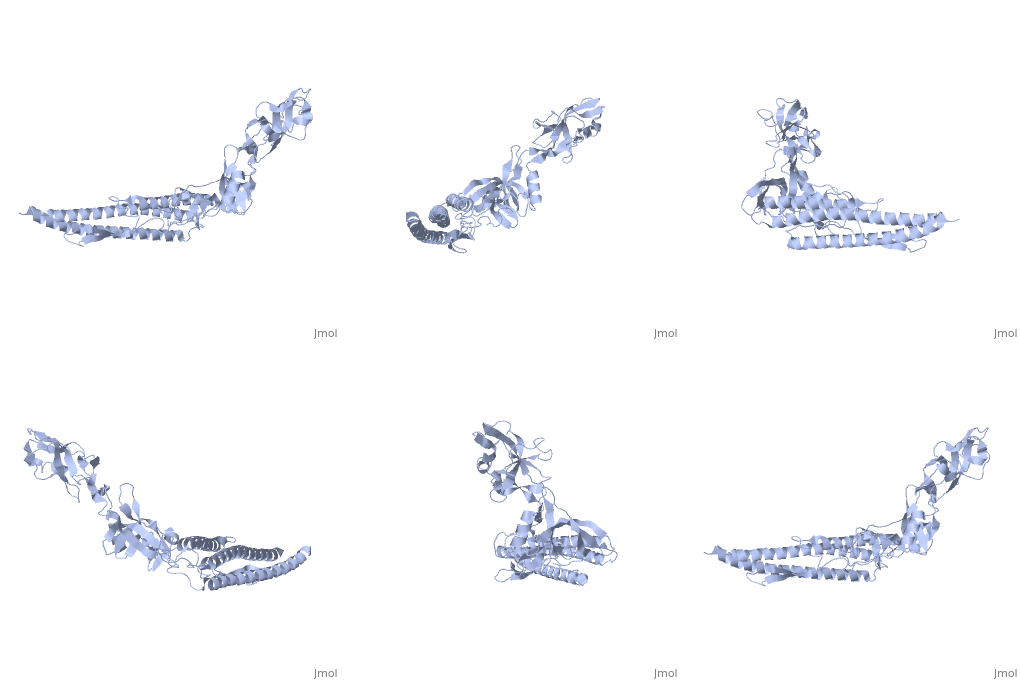

Lists of Flagellar Structures
These are automatically-generated lists of PDB codes.
- Special:Prefixindex/Category:Flagell includes categories beginning with Flagellar, Flagellin, Flagella, Flagellum.
- Special:Prefixindex/Category:Bacterial flagell
- Category:Chlamydomonas flagella
- Category:The bacterial flagellar motor
- Category:Putative flagellar motor switch protein flin
and there are undoubtedly other flagellum-related Categories ...
See Also
Within Proteopedia:
External Links
- Flagellum at Wikipedia
- Protonic Nanomachine Group, Osaka University
- MOVIES from the Protonic Nanomachine Project, Osaka University
</StructureSection>
References and Notes
- ↑ Lockman HA, Curtiss R 3rd. Salmonella typhimurium mutants lacking flagella or motility remain virulent in BALB/c mice. Infect Immun. 1990 Jan;58(1):137-43. PMID:2152887
- ↑ Daniels R, Vanderleyden J, Michiels J. Quorum sensing and swarming migration in bacteria. FEMS Microbiol Rev. 2004 Jun;28(3):261-89. PMID:15449604
- ↑ Yildiz FH, Visick KL. Vibrio biofilms: so much the same yet so different. Trends Microbiol. 2009 Mar;17(3):109-18. Epub 2009 Feb 21. PMID:19231189 doi:10.1016/j.tim.2008.12.004
- ↑ Lemon KP, Higgins DE, Kolter R. Flagellar motility is critical for Listeria monocytogenes biofilm formation. J Bacteriol. 2007 Jun;189(12):4418-24. Epub 2007 Apr 6. PMID:17416647 doi:10.1128/JB.01967-06
- ↑ Guerry P. Campylobacter flagella: not just for motility. Trends Microbiol. 2007 Oct;15(10):456-61. Epub 2007 Oct 24. PMID:17920274 doi:10.1016/j.tim.2007.09.006
- ↑ Minamino T, Imada K, Namba K. Mechanisms of type III protein export for bacterial flagellar assembly. Mol Biosyst. 2008 Nov;4(11):1105-15. Epub 2008 Sep 24. PMID:18931786 doi:10.1039/b808065h
Proteopedia Page Contributors and Editors (what is this?)
Eric Martz, Michal Harel, Joel L. Sussman, Fadel A. Samatey, Jaime Prilusky
