Akt/PKB signaling pathway
From Proteopedia
(Difference between revisions)
| Line 1: | Line 1: | ||
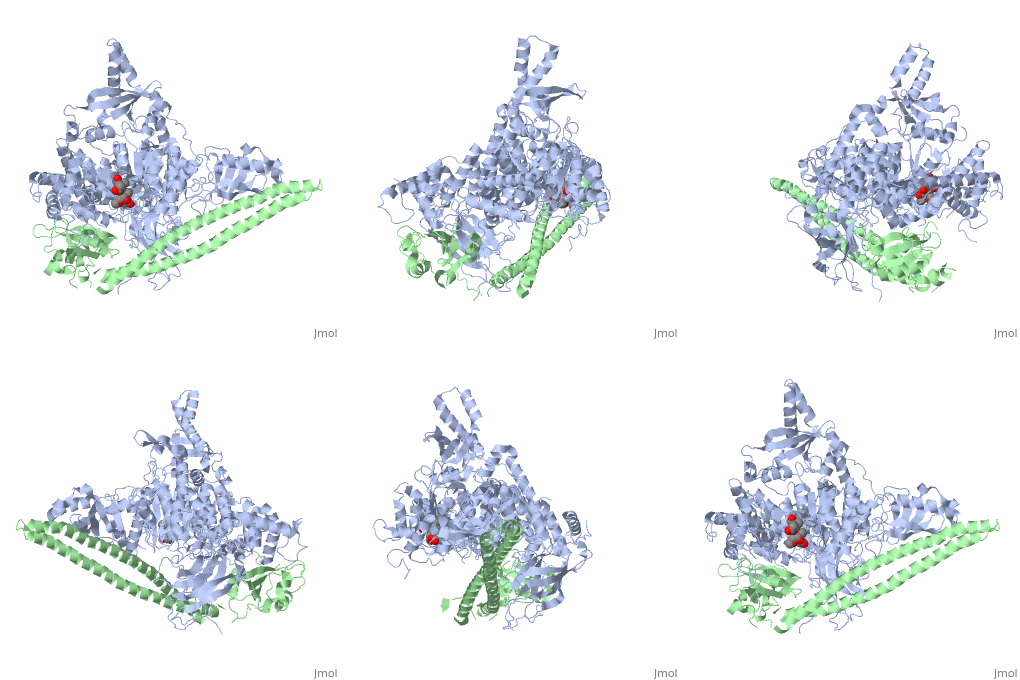
<StructureSection load='3hhm' size='350' side='right' scene='' caption='PI3K (grey) complex with NISH2 P85α and wortmannin (PDB code [[3hhm]]) '> | <StructureSection load='3hhm' size='350' side='right' scene='' caption='PI3K (grey) complex with NISH2 P85α and wortmannin (PDB code [[3hhm]]) '> | ||
| - | The Akt signaling pathway or PI3K-Akt signaling pathway is a signal transduction pathway that promotes survival and growth in response to extracellular signals. Key proteins involved are PI3K ([[phosphatidylinositol 3-kinase]]) and Akt (protein kinase B). See also [[Signal transduction]]. | + | The Akt signaling pathway or PI3K-Akt signaling pathway is a signal transduction pathway that promotes survival and growth in response to extracellular signals. Key proteins involved are PI3K ([[phosphatidylinositol 3-kinase]]) and Akt (protein kinase B). Protein kinase B (PKB), also known as Akt, is the collective name of a set of three serine/threonine-specific protein kinases that play key roles in multiple cellular processes such as glucose metabolism, apoptosis, cell proliferation, transcription, and cell migration. See also [[Signal transduction]]. |
=Activation Akt/PKB via Receptor tyrosine kinases/Ras= | =Activation Akt/PKB via Receptor tyrosine kinases/Ras= | ||
Revision as of 11:10, 1 March 2022
| |||||||||||