This old version of Proteopedia is provided for student assignments while the new version is undergoing repairs. Content and edits done in this old version of Proteopedia after March 1, 2026 will eventually be lost when it is retired in about June of 2026.
Apply for new accounts at the new Proteopedia. Your logins will work in both the old and new versions.
Helicase
From Proteopedia
| (30 intermediate revisions not shown.) | |||
| Line 1: | Line 1: | ||
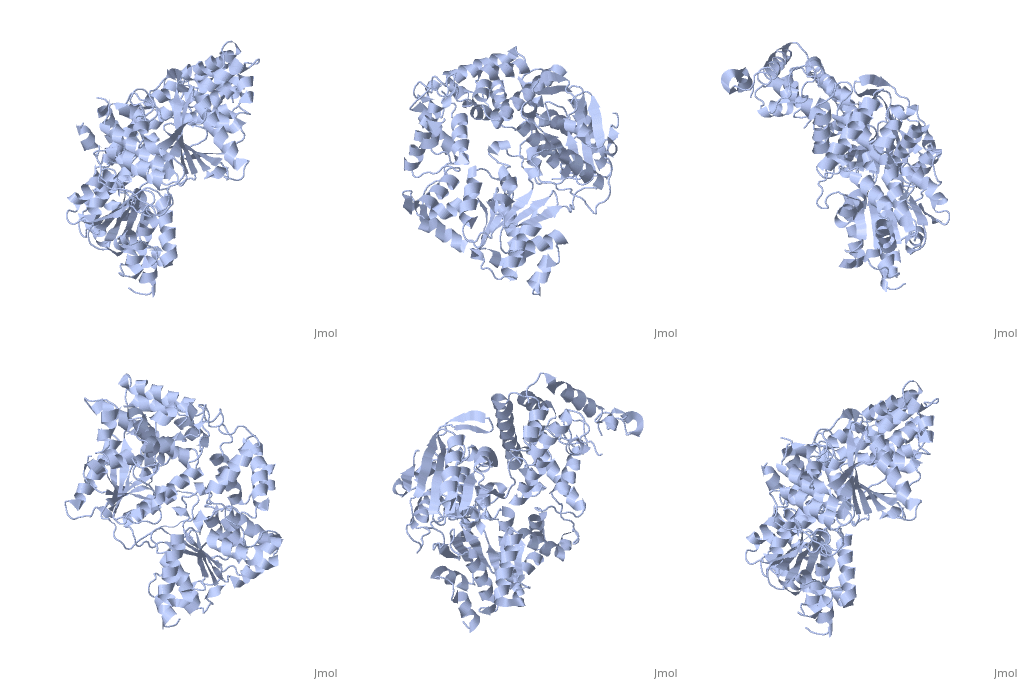
| - | + | <StructureSection load='1pjr' size='350' side='right' scene='' caption='DNA-dependent helicase PcrA (PDB code [[1pjr]])'> | |
| - | + | == Function == | |
'''Helicase''' (Hel) is a motor protein which separates nucleic acid strands like DNA double helix or self-annealed RNA. They use ATP hydrolysis for energy. Hel falls into 5 superfamilies (SF1-SF5). Some Hel contain a Helicase and RNase D C terminal | '''Helicase''' (Hel) is a motor protein which separates nucleic acid strands like DNA double helix or self-annealed RNA. They use ATP hydrolysis for energy. Hel falls into 5 superfamilies (SF1-SF5). Some Hel contain a Helicase and RNase D C terminal | ||
| - | Domain (HRDC). The α-thalassemia and mental retardation X-linked syndrome helicase (ATRX ), contains an ATRX-Dnmt3-Dnmt3L (ADD) domain in which many disease-related mutations are found. | + | Domain (HRDC). The α-thalassemia and mental retardation X-linked syndrome helicase (ATRX ), contains an ATRX-Dnmt3-Dnmt3L (ADD) domain in which many disease-related mutations are found.<br /> |
| + | '''ATP-dependent helicase Rho''' is a protein involved in termination of transcription in prokaryotes. Rho binds to the transcription terminator site on single-stranded RNA. Rho forms a ring-shaped hexamer and advances along the mRNA until it reaches the RNA polymerase and causing it to dissociate from the DNA and end transcription.<br /> | ||
| + | '''ATP-dependent helicase RuvB-like 1''' (RuvBL1) or '''TIP49''' is a human protein which forms hexamers. The hexamer forms dodecamer upon association with RuvBL2 or '''TIP48''' and the complex possesses single-stranded DNA-stimulated ATPase and helicase activities. | ||
For details of PcrA helicase see<br /> | For details of PcrA helicase see<br /> | ||
| Line 13: | Line 15: | ||
For ATP-dependent helicase RecG see <br /> | For ATP-dependent helicase RecG see <br /> | ||
*[[RecG Bound to Three-Way DNA Junction]]. <br /> | *[[RecG Bound to Three-Way DNA Junction]]. <br /> | ||
| + | For ATP-dependent helicase HepA see <br /> | ||
| + | *[[RapA, a Swi2/Snf2 protein]]. <br /> | ||
For DEAD box ATP-dependent RNA helicase see <br /> | For DEAD box ATP-dependent RNA helicase see <br /> | ||
*[[C-terminal domain of the DEAD-box protein Dbp5]]<br /> | *[[C-terminal domain of the DEAD-box protein Dbp5]]<br /> | ||
| Line 18: | Line 22: | ||
*[[Dead-box RNA helicase DDX19, in complex with an ATP-analogue and RNA]]. <br /> | *[[Dead-box RNA helicase DDX19, in complex with an ATP-analogue and RNA]]. <br /> | ||
*[[Structural basis for RNA unwinding by the DEAD-box protein Drosophila Vasa]]<br /> | *[[Structural basis for RNA unwinding by the DEAD-box protein Drosophila Vasa]]<br /> | ||
| + | For helicase XPD see<br /> | ||
| + | *[[XPD Helicase (3CRV)]]<br /> | ||
| + | For helicase II or UvrD see<br /> | ||
| + | *[[DNA Repair]]<br /> | ||
| + | For SARS-CoV-2 helicase nsp13 see<br /> | ||
| + | *[[SARS-CoV-2 enzyme Hel]]<br /> | ||
See also<br /> | See also<br /> | ||
*[[Transcription and RNA Processing]] | *[[Transcription and RNA Processing]] | ||
| - | *[[Brr2]] | + | *[[Brr2]] - pre-mRNA-splicing helicase. |
== What is a Helicase? == | == What is a Helicase? == | ||
| Line 30: | Line 40: | ||
[[Image:Pcr4_structures.jpg|thumb|300px|left|PcrA_Structure]] | [[Image:Pcr4_structures.jpg|thumb|300px|left|PcrA_Structure]] | ||
| + | {{clear}} | ||
PcrA is part of the replication machinery of the [http://en.wikipedia.org/wiki/Geobacillus_stearothermophilus Geobacillus stearothermophilus]a gram (+) bacteria, This helicase is part of the superfamily I of Helicases. Monomeric protein that is mainly <scene name='User:Luis_E_Ramirez-Tapia/Sandbox_1/Initial/1'>alpha helical</scene> has the <scene name='User:Luis_E_Ramirez-Tapia/Sandbox_2/1pjrconser/2'>highly conserved</scene> Rec domians. This helicase was reported as a mutation in the gen PcrA from [http://en.wikipedia.org/wiki/staphylococcu "Stapphylococcus aerous"], this mutation was related to a deficiency in the replication of a reporter plasmid.[http://www.ncbi.nlm.nih.gov/pubmed/8232203?ordinalpos=81&itool=EntrezSystem2.PEntrez.Pubmed.Pubmed_ResultsPanel.Pubmed_DefaultReportPanel.Pubmed_RVDocSum] | PcrA is part of the replication machinery of the [http://en.wikipedia.org/wiki/Geobacillus_stearothermophilus Geobacillus stearothermophilus]a gram (+) bacteria, This helicase is part of the superfamily I of Helicases. Monomeric protein that is mainly <scene name='User:Luis_E_Ramirez-Tapia/Sandbox_1/Initial/1'>alpha helical</scene> has the <scene name='User:Luis_E_Ramirez-Tapia/Sandbox_2/1pjrconser/2'>highly conserved</scene> Rec domians. This helicase was reported as a mutation in the gen PcrA from [http://en.wikipedia.org/wiki/staphylococcu "Stapphylococcus aerous"], this mutation was related to a deficiency in the replication of a reporter plasmid.[http://www.ncbi.nlm.nih.gov/pubmed/8232203?ordinalpos=81&itool=EntrezSystem2.PEntrez.Pubmed.Pubmed_ResultsPanel.Pubmed_DefaultReportPanel.Pubmed_RVDocSum] | ||
| - | |||
<table align='right'><tr><td> </td><td>{{Template:ColorKey_ConSurf}}</td></tr></table> | <table align='right'><tr><td> </td><td>{{Template:ColorKey_ConSurf}}</td></tr></table> | ||
| Line 39: | Line 49: | ||
PcrA is has an ATPas activityt which directionality is from 3' to 5' helicase strand separation reaction. The enzyme shows a specificity for the DNA substrate in gel mobility assays with the preferred substrate being one containing both single and double stranded regions of DNA. In contrast to Rep and UvrD from E. coli, there is not evidence for dimerisation of the enzyme using gel filtration, or by crosslinking in the presence of combinations of Mg2+, nucleotides and DNA. Moreover, kcat for ATP hydrolysis is constant over a large range of protein concentrations. Therefore, the protein appears to be monomeric under all conditions tested, including in the structure of two crystal forms of PcrA.[http://www.icnet.uk/labs/wigley/projects/helicase/35.html] | PcrA is has an ATPas activityt which directionality is from 3' to 5' helicase strand separation reaction. The enzyme shows a specificity for the DNA substrate in gel mobility assays with the preferred substrate being one containing both single and double stranded regions of DNA. In contrast to Rep and UvrD from E. coli, there is not evidence for dimerisation of the enzyme using gel filtration, or by crosslinking in the presence of combinations of Mg2+, nucleotides and DNA. Moreover, kcat for ATP hydrolysis is constant over a large range of protein concentrations. Therefore, the protein appears to be monomeric under all conditions tested, including in the structure of two crystal forms of PcrA.[http://www.icnet.uk/labs/wigley/projects/helicase/35.html] | ||
| - | [[Image:Wigleypcr4.jpg]] | + | [[Image:Wigleypcr4.jpg|thumb|300px|left]] |
| - | + | {{clear}} | |
==PcrA Helicase Mechanism : The Mexican Wave== | ==PcrA Helicase Mechanism : The Mexican Wave== | ||
| - | {{STRUCTURE_1pjr| PDB=3pjr | SCENE='User:Luis_E_Ramirez-Tapia/Sandbox_2/3pjrinitial/1'}} | ||
Professor Dale B. Wigley' group in 1996-1999 was able to crystalize the intermediate states from PcrA, giving solution to the controversy of what kind of mechanism this helicase has. [http://www.ncbi.nlm.nih.gov/pubmed/10199404ordinalpos=39&itool=EntrezSystem2.PEntrez.Pubmed.Pubmed_ResultsPanel.Pubmed_DefaultReportPanel.Pubmed_RVDocSum] | Professor Dale B. Wigley' group in 1996-1999 was able to crystalize the intermediate states from PcrA, giving solution to the controversy of what kind of mechanism this helicase has. [http://www.ncbi.nlm.nih.gov/pubmed/10199404ordinalpos=39&itool=EntrezSystem2.PEntrez.Pubmed.Pubmed_ResultsPanel.Pubmed_DefaultReportPanel.Pubmed_RVDocSum] | ||
| - | Two crystal form of the enzyma, one couple with a 10 mer DNA and a non hydrolizable form of ATP (ATPnP) (pdb id: [[3pjr]], <scene name='User:Luis_E_Ramirez-Tapia/Sandbox_2/3pjrinitial/1'> (Enzyme | + | Two crystal form of the enzyma, one couple with a 10 mer DNA and a non hydrolizable form of ATP (ATPnP) (pdb id: [[3pjr]], <scene name='User:Luis_E_Ramirez-Tapia/Sandbox_2/3pjrinitial/1'> (Enzyme Substrate Structure) </scene>and another a truncated form embebed in sulfate (pdb id: [[2pjr]]<scene name='User:Luis_E_Ramirez-Tapia/Sandbox_2/2pjrinitial/1'> (Enzyme Product Structure)</scene>, give a light in a model for how ATP hydrolysis results in motor movement along ssDNA. In the figure below step 1 (top) is the ATP free (product) ssDNA conformation. The DNA bases are labelled arbitrarily. On binding ATP, F626 creates a new binding pocket for base 6. Likewise, F64 destroys an acceptor pocket for base 2, forcing it to move to the position occupied by base 1. After ATP hydrolysis, the grip on base 6 is released. When the Y257 pocket is re-opened due to movement of F64, bases 3-6 can now flip through the acceptor pockets to their new positions. This model predicts that each ATP hydrolysis event will advance PcrA one base along ssDNA.[http://www.icnet.uk/labs/wigley/projects/helicase/35.html] |
[[Image:Mexicanwave.jpg|thumb|170px|left|Inchworm or Mexicanwave model]] | [[Image:Mexicanwave.jpg|thumb|170px|left|Inchworm or Mexicanwave model]] | ||
[[Image:Snapshot_2008-12-03_14-11-31.jpg|thumb|400px|center|PcrA Movie]] | [[Image:Snapshot_2008-12-03_14-11-31.jpg|thumb|400px|center|PcrA Movie]] | ||
| - | |||
'''The link below show a movie with the principal characteristics of this protain as long with the inchworm mode'''. [http://www.youtube.com/watch?v=fDwaWCkhgZI Pcr4 Helicase and Mexican Wave] | '''The link below show a movie with the principal characteristics of this protain as long with the inchworm mode'''. [http://www.youtube.com/watch?v=fDwaWCkhgZI Pcr4 Helicase and Mexican Wave] | ||
| Line 53: | Line 61: | ||
==The Superfamily 1 (SF1)== | ==The Superfamily 1 (SF1)== | ||
| - | PcrA share structural domains with the Rec helicases, like UvrD and RepD from E. coli, Superfamily 1 (SF1) helicases are probably the best characterized class, certainly from a structural perspective. All members characterized to date are bona fide helicases and α enzymes. Indeed, from their mode of translocation via the bases it is difficult to envisage how they could translocate along a duplex. However, they can have either A or B directional polarity. | + | PcrA share structural domains with the Rec helicases, like UvrD ([[2is1]]) and RepD ([[1uaa]]) from E. coli, Superfamily 1 (SF1) helicases are probably the best characterized class, certainly from a structural perspective. All members characterized to date are bona fide helicases and α enzymes. Indeed, from their mode of translocation via the bases it is difficult to envisage how they could translocate along a duplex. However, they can have either A or B directional polarity. |
{{clear}} | {{clear}} | ||
| + | ==3D structures of helicase== | ||
| + | [[Helicase 3D structures]] | ||
| - | + | </StructureSection> | |
| - | + | ||
| - | + | ||
| - | + | ||
| - | + | ||
| - | + | ||
| - | + | ||
| - | + | ||
| - | + | ||
| - | + | ||
| - | + | ||
| - | + | ||
| - | + | ||
| - | + | ||
| - | + | ||
| - | + | ||
| - | + | ||
| - | + | ||
| - | + | ||
| - | + | ||
| - | + | ||
| - | + | ||
| - | + | ||
| - | + | ||
| - | + | ||
| - | + | ||
| - | + | ||
| - | + | ||
| - | + | ||
| - | + | ||
| - | + | ||
| - | + | ||
| - | + | ||
| - | + | ||
| - | + | ||
| - | + | ||
| - | + | ||
| - | + | ||
| - | + | ||
| - | + | ||
| - | + | ||
| - | + | ||
| - | + | ||
| - | + | ||
| - | + | ||
| - | + | ||
| - | + | ||
| - | + | ||
| - | + | ||
| - | + | ||
| - | + | ||
| - | + | ||
| - | + | ||
| - | + | ||
| - | + | ||
| - | + | ||
| - | + | ||
| - | + | ||
| - | + | ||
| - | + | ||
| - | + | ||
| - | + | ||
| - | + | ||
| - | + | ||
| - | + | ||
| - | + | ||
| - | + | ||
| - | + | ||
| - | + | ||
| - | + | ||
| - | + | ||
| - | + | ||
| - | + | ||
| - | + | ||
| - | + | ||
| - | + | ||
| - | + | ||
| - | + | ||
| - | + | ||
| - | + | ||
| - | + | ||
| - | + | ||
| - | + | ||
| - | + | ||
| - | + | ||
| - | + | ||
| - | + | ||
| - | + | ||
| - | + | ||
| - | + | ||
| - | + | ||
| - | + | ||
| - | + | ||
| - | + | ||
| - | + | ||
| - | + | ||
| - | + | ||
| - | + | ||
| - | + | ||
| - | + | ||
| - | + | ||
| - | + | ||
| - | + | ||
| - | + | ||
| - | + | ||
| - | + | ||
| - | + | ||
| - | + | ||
| - | + | ||
| - | + | ||
| - | + | ||
| - | + | ||
| - | + | ||
| - | + | ||
| - | + | ||
| - | + | ||
| - | + | ||
| - | + | ||
| - | + | ||
| - | + | ||
| - | + | ||
| - | + | ||
| - | + | ||
| - | + | ||
| - | + | ||
| - | + | ||
| - | + | ||
| - | + | ||
| - | + | ||
| - | + | ||
| - | + | ||
| - | + | ||
| - | + | ||
| - | + | ||
| - | + | ||
| - | + | ||
| - | + | ||
| - | + | ||
| - | + | ||
| - | + | ||
| - | + | ||
| - | + | ||
| - | + | ||
| - | + | ||
| - | + | ||
| - | + | ||
| - | + | ||
| - | + | ||
| - | + | ||
| - | + | ||
| - | + | ||
| - | + | ||
| - | + | ||
| - | + | ||
| - | + | ||
| - | + | ||
| - | + | ||
| - | + | ||
| - | + | ||
| - | + | ||
| - | + | ||
| - | + | ||
| - | + | ||
| - | + | ||
| - | + | ||
| - | + | ||
| - | + | ||
| - | + | ||
| - | + | ||
| - | + | ||
| - | + | ||
| - | + | ||
| - | + | ||
| - | + | ||
| - | + | ||
| - | + | ||
| - | + | ||
| - | + | ||
| - | + | ||
| - | + | ||
| - | + | ||
| - | + | ||
| - | + | ||
| - | + | ||
| - | + | ||
| - | + | ||
| - | + | ||
| - | + | ||
| - | + | ||
| - | + | ||
| - | + | ||
| - | + | ||
| - | + | ||
| - | + | ||
| - | + | ||
| - | + | ||
| - | + | ||
| - | + | ||
| - | + | ||
| - | + | ||
| - | + | ||
| - | + | ||
| - | + | ||
| - | + | ||
| - | + | ||
| - | + | ||
| - | + | ||
| - | + | ||
| - | + | ||
| - | + | ||
| - | + | ||
| - | + | ||
| - | + | ||
| - | + | ||
| - | + | ||
| - | + | ||
| - | + | ||
| - | + | ||
| - | + | ||
| - | + | ||
| - | + | ||
| - | + | ||
| - | + | ||
| - | + | ||
| - | + | ||
| - | + | ||
| - | + | ||
| - | + | ||
| - | + | ||
| - | + | ||
| - | + | ||
| - | + | ||
| - | + | ||
| - | + | ||
| - | + | ||
| - | + | ||
| - | + | ||
| - | + | ||
| - | + | ||
| - | + | ||
| - | + | ||
| - | + | ||
| - | + | ||
| - | + | ||
| - | + | ||
| - | + | ||
| - | + | ||
| - | + | ||
| - | + | ||
| - | + | ||
| - | + | ||
| - | + | ||
| - | + | ||
| - | + | ||
| - | + | ||
| - | + | ||
| - | + | ||
==References== | ==References== | ||
| Line 337: | Line 91: | ||
[[Category: Helicase]] | [[Category: Helicase]] | ||
[[Category: Sos response]] | [[Category: Sos response]] | ||
| - | + | ||
| + | =='''Content Donators'''== | ||
| + | Created with the participation of [[User:Luis E Ramirez-Tapia|Luis E Ramirez-Tapia]], [[User:Wayne Decatur|Wayne Decatur]]. | ||
Current revision
| |||||||||||


References
Crystal structure of a DExx box DNA helicase., Subramanya HS, Bird LE, Brannigan JA, Wigley DB, Nature. 1996 Nov 28;384(6607):379-83. PMID:8934527
^ Johnson DS, Bai L, Smith BY, Patel SS, Wang MD (2007). "Single-molecule studies reveal dynamics of DNA unwinding by the ring-shaped t7 helicase". Cell 129 (7): 1299–309. doi:10.1016/j.cell.2007.04.038. PMID 17604719.
^ a b "Researchers solve mystery of how DNA strands separate" (2007-07-03). Retrieved on 2007-07-05.
^ Dumont S, Cheng W, Serebrov V, Beran RK, Tinoco Jr I, Pylr AM, Bustamante C, "RNA Translocation and Unwinding Mechanism of HCV NS3 Helicase and its Coordination by ATP", Nature. 2006 Jan 5; 439: 105-108.
Anand SP, Zheng H, Bianco PR, Leuba SH, Khan SA. DNA helicase activity of PcrA is not required for displacement of RecA protein from DNA or inhibition of RecA-mediated DNA strand exchange. Journal of Bacteriology (2007) 189 (12):4502-4509.
Bird L, Subramanya HS, Wigley DB, "Helicases: a unifying structural theme?", Current Opinion in Structural Biology. 1998 Feb; 8 (1): 14-18.
Betterton MD, Julicher F, "Opening of nucleic-acid double strands by helicases: active versus passive opening.", Physical Review E. 2005 Jan; 71 (1): 011904.
- Sengoku T, Nureki O, Nakamura A, Kobayashi S, Yokoyama S. Structural basis for RNA unwinding by the DEAD-box protein Drosophila Vasa. Cell. 2006 Apr 21;125(2):287-300. PMID:16630817 doi:10.1016/j.cell.2006.01.054
- Sengoku T, Nureki O, Dohmae N, Nakamura A, Yokoyama S. Crystallization and preliminary X-ray analysis of the helicase domains of Vasa complexed with RNA and an ATP analogue. Acta Crystallogr D Biol Crystallogr. 2004 Feb;60(Pt 2):320-2. Epub 2004, Jan 23. PMID:14747711 doi:10.1107/S0907444903025897
Content Donators
Created with the participation of Luis E Ramirez-Tapia, Wayne Decatur.
Proteopedia Page Contributors and Editors (what is this?)
Michal Harel, Alexander Berchansky, Wayne Decatur, Joel L. Sussman
