We apologize for Proteopedia being slow to respond. For the past two years, a new implementation of Proteopedia has been being built. Soon, it will replace this 18-year old system. All existing content will be moved to the new system at a date that will be announced here.
Antibody
From Proteopedia
(Difference between revisions)
| (139 intermediate revisions not shown.) | |||
| Line 1: | Line 1: | ||
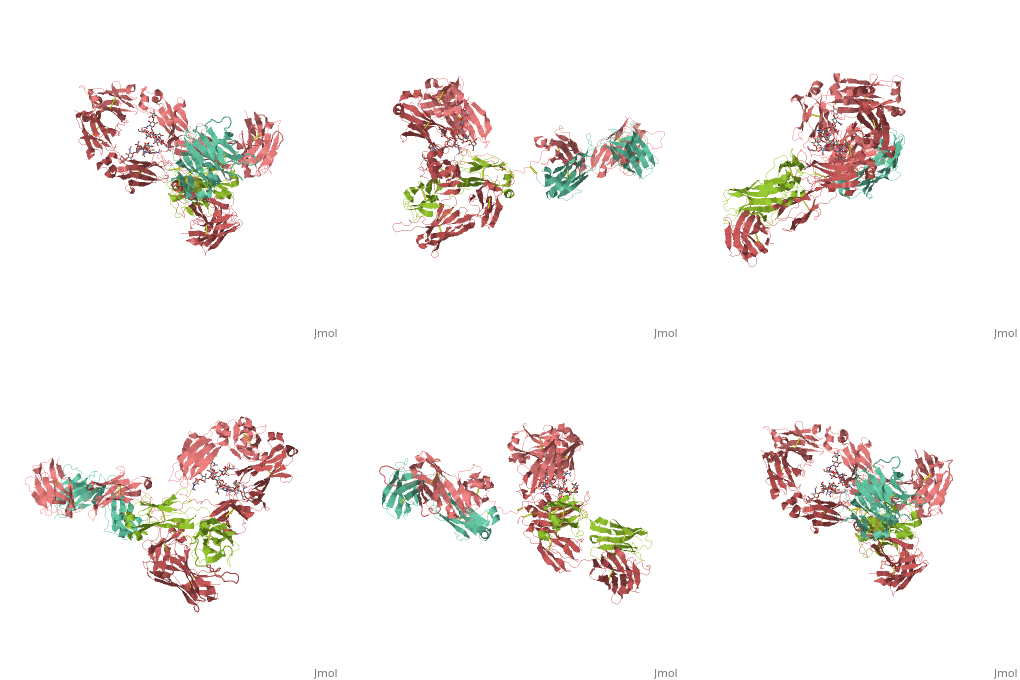
| - | + | <StructureSection load='1hzh' size='350' side='right' scene='' caption='Glycosylated human Igg with heavy chains (red and light red), light chains (aqua and green) (PDB code [[1hzh]])'> | |
| - | + | ||
| - | Antibodies, also known as | + | '''Antibodies''', also known as '''Immunoglobulins''' (Ig) are gamma globulin proteins, primarily found in the blood of vertebrates. These [[glycoproteins]] serve as a critical component of the immune system when the host fails to activate alternative compliment pathways or phagocytic cells in response to invading microorganisms or other [http://en.wikipedia.org/wiki/Antigen antigens]. The incredible specificity with which immunoglobulins bind to an antigen is based upon structural complementarity between the antigen and antibody <scene name='Antibody/1hzh_heavy_chains/1'>heavy </scene>and <scene name='Antibody/1hzh_light_chains/1'>light chains </scene>. It is this specificity that has made <scene name='Antibody/1hzh_starting_scene/3'>antibodies</scene> a critical component in laboratory and medical research. <br /> |
| + | *'''Humanized mouse antibody (hmFab)''' is a modified mFab which resembles more hFab.<br /> | ||
| + | *'''Broadly neutralizing Fab''' and '''Neutralizing Fab''' are anti-virus Fab. <br /> | ||
| + | *'''Intrabody''' is intracellular antibody. <br /> | ||
| + | *'''Sybody''' is synthetic nanobody (syVHH).<br /> | ||
| + | *'''Diabody''' is a recombinant bispecific antibody constructed from heterogenous single chain antibody. <br /> | ||
| + | *'''Lama antibodies''' or '''nanobodies''' or '''camelid''' or '''VHH''' are natural single-domain antibodies containing just the heavy chain.<br /> | ||
| + | *'''scFv''' is a '''single chain variable fragment''' in a fusion protein of the variable regions of the heavy and light chains of immunoglobulin. <br /> | ||
| + | *'''VH domain''' is the variable domain of the antibody heavy chain.<br /> | ||
| + | *'''Bispecific antibody''' or '''biparatopic antibody''' can bind to two epitopes of an antigen simultaneously.<br /> | ||
| + | *'''Polyclonal antibodies''' are a mixture of antibodies that bind to several epitopes of an antigen simultaneously.<br /> | ||
| + | *'''Ultralong antibody''' is found in bovine. It has unusually long CDR H3 regions and has more effective defence against disease than typical antibodies <br /> | ||
| + | *'''Gluebody''' is a modified nanobody which produces far superior resolution of diffraction upon binding to protein.<br /> | ||
| + | *'''Monobody''' is an antibody mimic synthetic protein containing a FN3 domain of fibronectin. <br /> | ||
| - | + | See more in<br /> | |
| - | <br /> | + | [[IgA]]<br /> |
| + | [[IgG Branco]]<br /> | ||
| + | [[Monoclonal Antibody]].<br /> | ||
| + | For Anti-HIV-1 antibodies see [[Human Fab PG16]] and [[VRC01 gp120 complex|VRC01 and VRC01-like antibodies are important in neutralizing HIV-1]]<br /> | ||
| + | For Anti-VEGF Fab see [[Bevacizumab]] (Avastin)<br /> | ||
| + | For Anti-factor IX Fab see [[Conformation-specific anti-Factor IX antibodies]]<br /> | ||
| + | For blue luminescent Fab see [[Blue Luminescent Antibody Derived from House Mouse]]<br /> | ||
| + | For Anti-vitamin Fab see [[MR1 Binds Vitamin Metabolites]]<br />. | ||
| - | [[Image:Th_Lymphokines.JPG|300px|left|thumb| Production of Antibodies by Plasma Cells]] | ||
| + | [[Image:230px-B cell activation2.png|270px|left|thumb| Production of Antibodies by Plasma Cells]] | ||
| + | {{Clear}} | ||
| + | __TOC__ | ||
==Cellular Basis of Antibody Production== | ==Cellular Basis of Antibody Production== | ||
| - | When a foreign antigen binds to a B-lymphocyte ([http://en.wikipedia.org/wiki/B_cell B-cell]), it activates the B-cell, and upon stimulation by [http://en.wikipedia.org/wiki/Helper_t_cell helper T- | + | When a foreign antigen binds to a B-lymphocyte ([http://en.wikipedia.org/wiki/B_cell B-cell]), it activates the B-cell, and upon stimulation by [http://en.wikipedia.org/wiki/Helper_t_cell helper T-cells], undergoes clonal proliferation and B-cell maturation into antibody forming [http://en.wikipedia.org/wiki/Plasma_cells plasma cells]. Each plasma cell is programmed to make an antibody of a single specificity, which it releases into the blood. <ref name="Roit"> Roit, I. M. Roit's Essential Immunology. Oxford: Blackwell Science Ltd., 1997.</ref> Once in the blood, antibodies aid [http://en.wikipedia.org/wiki/Humoral_immune_system the humoral immune system] in three predominant ways: They coat foreign pathogens preventing them from entering healthy cells or disrupting antigen function; they coat pathogens, stimulating their removal via [http://en.wikipedia.org/wiki/Opsonization opsonization] by [http://en.wikipedia.org/wiki/Phagocytes phagocytes]; and they trigger destruction of pathogens by stimulating the [http://en.wikipedia.org/wiki/Complement_system complement pathway] or by [http://en.wikipedia.org/wiki/Antibody-dependent_cellular_cytotoxicity Antibody Dependent Cell-mediated Cytotoxicity], among other immune responses. <ref>PMID:8476565</ref> <ref>PMID:16234578</ref> All of these functions rely heavily on accurate antigen binding and communication with other immune effector cells. The amazing specificity antibodies operate with is made possible by the physical structure of the antibody, which appears simplistic, but contains several levels of additional complexity. |
==Structure of the Immunoglobulin== | ==Structure of the Immunoglobulin== | ||
| + | <scene name='Antibody/1igt_starting_scene/3'>Refined Structure of an Intact IgG2a Monoclonal Antibody</scene> ([[1igt]]). | ||
| - | The basic functional unit of an antibody is an immunoglobulin monomer, but antibodies secreted from plasma cells are typically dimeric with occasional higher order structures. Typical secreted antibodies have a basic four-peptide structure of two identical heavy and two identical light chains joined together by interchain disulfide bonds, forming a “Y” shaped molecule. < | + | The basic functional unit of an antibody is an immunoglobulin monomer, but antibodies secreted from plasma cells are typically dimeric with occasional higher order structures. Typical secreted antibodies have a basic four-peptide structure of two identical <scene name='Antibody/1igt_heavy_chains/1'>heavy chains </scene>and two identical <scene name='Antibody/1igt_light_chains/1'>light chains</scene> joined together by interchain <scene name='Antibody/1igt_disulfide_bonds/2'>disulfide bonds</scene>, forming a “Y” shaped molecule. The disulfide bonds are positioned within a flexible region called the <scene name='Antibody/1igt_hinge_region/1'>hinge region</scene>, which seperates the lobes of the antibody from one another and provides ample flexibility to bind antigens effectively. <ref name="Roit" /> Each domain (2 heavy and 2 light) contain between 70-110 amino acids and are classified into different categories according to size and function. <ref>PMID:10545762</ref> Both domains, heavy and light, contain variable and constant regions that are crucial to antibody function. <ref>PMID:107164</ref> |
| - | {{STRUCTURE_1igt| right| PDB=1igt | Size=400px| SCENE= |CAPTION= Refined Structure of an Intact IgG2a Monoclonal Antibody, [[1igt]] }} | ||
| - | |||
| - | [[Image:ANtibody parts.jpg|400px|left|thumb| Typical Structure of an Antibody <ref>http://www.virology.ws/wp-content/uploads/2009/07/antibody2.jpg</ref>]] | ||
===Heavy Chain=== | ===Heavy Chain=== | ||
| - | There are five types of immunoglobulin heavy chains, in mammals, α, δ, ε, γ, and μ, and give rise to the five unique classes or isotypes of antibodies, IgA, IgD, IgE, IgG, and IgM, which differ in size and composition. Each heavy chain has a constant region and variable region. The constant region is identical in all antibodies of the same isotype, but differ in antibodies of different isotypes; i.e. all IgA have the same sequence in their heavy chain constant region, but these constant regions differ between IgA and IgD, etc. <ref>PMID:15040582</ref> The α, δ, and γ heavy chains have a constant region composed of three tandem immunoglobulin domains while heavy chains ε and μ contain four. The variable region of the heavy chain in antibodies is different for all antibodies created by different B-cells. <ref>PMID:107164</ref> | + | There are five types of immunoglobulin heavy chains, in mammals, α, δ, ε, γ, and μ, and give rise to the five unique classes or isotypes of antibodies, IgA, IgD, IgE, IgG, and IgM, which differ in size and composition. Each <scene name='Antibody/1igt_heavy_chains_ribbon/1'>heavy chain </scene>has a <scene name='Antibody/1igt_startconstant_region/1'>constant region </scene> and <scene name='Antibody/1igt_start_heavy_variable/1'>variable region</scene>. The constant region is identical in all antibodies of the same isotype, but differ in antibodies of different isotypes; i.e. all IgA have the same sequence in their heavy chain constant region, but these constant regions differ between IgA and IgD, etc. <ref>PMID:15040582</ref> The α, δ, and γ heavy chains have a constant region composed of <scene name='Antibody/1igt_heavy_3_chains/1'>three tandem immunoglobulin domains</scene> while heavy chains ε and μ contain four. The variable region of the heavy chain in antibodies is different for all antibodies created by different B-cells. <ref>PMID:107164</ref> |
| + | |||
| + | [[Image:New Antibody2.JPG|450px|left|thumb| Typical Structure of an Antibody]] | ||
===Light Chain=== | ===Light Chain=== | ||
| - | Every antibody contains two light chains that are identical to each other. There are two types of immunoglobulin light chains in mammals, labeled lambda and kappa, with only one represented in each antibody. Each light chain has one constant domain followed by one variable domain, with a total length of about 215 amino acids. <ref | + | Every antibody contains two <scene name='Antibody/1igt_light_chains_ribbon/1'>light chains </scene>that are identical to each other. There are two types of immunoglobulin light chains in mammals, labeled lambda and kappa, with only one represented in each antibody. Each light chain has one <scene name='Antibody/1igt_light_chains_constnat_reg/1'>constant domain </scene>followed by one <scene name='Antibody/1igt_light_chain_variable/1'>variable domain</scene>, with a total length of about 215 amino acids. <ref name="Roit" /> |
=== The Regions: Fab, Fv, CDR, and Fc.=== | === The Regions: Fab, Fv, CDR, and Fc.=== | ||
The immunoglobulin can be broken down into regions, each serving a different purpose: | The immunoglobulin can be broken down into regions, each serving a different purpose: | ||
| - | |||
====Variable Regions==== | ====Variable Regions==== | ||
| - | The Fab region (Fragment, Antigen Binding region) is composed of one constant and one variable domain from each heavy and light chain of the antibody. It is the part of the antibody that gives it its famous “Y” shape.<ref>PMID:9048542</ref> Held within the Fab region is the variable domain, also known as the Fv region. Within the Fv region lie “hypervariable regions,” positioned at one end of the variable domain where they form parts of the Beta-turn loops and are clustered close to each other in space. The clustering of the hypervariable loops at the tips of the variable regions where the antigen-binding site is | + | The <scene name='Antibody/1igt_fab_region/1'>Fab region </scene>(Fragment, Antigen Binding region) is composed of one constant and one variable domain from each heavy and light chain of the antibody. It is the part of the antibody that gives it its famous “Y” shape.<ref>PMID:9048542</ref> Held within the Fab region is the variable domain, also known as the Fv region.<ref>PMID:4569769</ref> Within the Fv region lie <scene name='Antibody/1igt_start_variable_loops/1'>“hypervariable regions,”</scene> positioned at one end of the variable domain where they form parts of the Beta-turn loops and are clustered close to each other in space. The clustering of the hypervariable loops at the tips of the variable regions where the antigen-binding site is located makes them perfect candidates for antigen recognition. <ref name="Roit" />The sequence heterogeneity of the three heavy and three light chain hypervariable loops creates significant antigen specificity diversity through variations in the binding surface nature and shape. Each hypervariable region can be viewed as an independent structure contributing to the complementarity of the biding site and antigen and is often referred to as a complementarity determining region (CDR). <ref>PMID:107164</ref> |
====Constant Regions==== | ====Constant Regions==== | ||
| - | The remaining part of the antibody, namely the Fc region, does not play a role in binding the antigen, but rather is responsible for modulating the immune systems response to the formation of an antibody-antigen complex. The Fragment Crystallizable (Fc) region is composed of two heavy chain constant regions that are isotype specific. <ref>PMID:15040582</ref> Once an antibody binds to an antigen, the Fc region binds to Fc receptors, among other proteins, to mediate a host of different physiological responses ranging from oposonization, to degranulation of mast cells, to the release of cytokines and cytotoxic molecules, etc. resulting in the destruction of the pathogen. <ref>PMID:9052877</ref> Depending on the class of antibody, as dictated by the identity of the Fc region, the antibody half-life and distribution throughout the body varies. Further, since Fc receptors are antibody isotype specific, the type of immune response is dependent on the type of Fc region on the immunoglobulin, allowing for different immune responses to the same pathogen if necessary.<ref>PMID:11244038</ref> See table for brief characterization of Immunoglobulin isotypes | + | The remaining part of the antibody, namely the <scene name='Antibody/1igt_fc/2'>Fc region</scene>, does not play a role in binding the antigen, but rather is responsible for modulating the immune systems response to the formation of an antibody-antigen complex. The Fragment Crystallizable (Fc) region is composed of two heavy chain constant regions that are isotype specific. <ref>PMID:15040582</ref> Antibodies are glycoproteins because of <scene name='Antibody/1igt_glycosylation/1'>glycosylation </scene>at conserved positions in their Fc regions. This glycosylation is a critical component determing the rate of antibody clearance form the body.<ref>PMID:9032990</ref> Once an antibody binds to an antigen, the Fc region binds to Fc receptors, among other proteins, to mediate a host of different physiological responses ranging from oposonization, to degranulation of mast cells, to the release of cytokines and cytotoxic molecules, etc. resulting in the destruction of the pathogen. <ref>PMID:9052877</ref> Depending on the class of antibody, as dictated by the identity of the Fc region, the antibody half-life and distribution throughout the body varies. Further, since Fc receptors are antibody isotype specific, the type of immune response is dependent on the type of Fc region on the immunoglobulin, allowing for different immune responses to the same pathogen if necessary.<ref>PMID:11244038</ref> See table for brief characterization of Immunoglobulin isotypes: |
{| class="wikitable" border="1" width="70%" style="text-align:center" | {| class="wikitable" border="1" width="70%" style="text-align:center" | ||
| Line 40: | Line 60: | ||
|- | |- | ||
! Class | ! Class | ||
| - | ! Function and Oligomeric State<ref | + | ! Function and Oligomeric State<ref name="Roit" /> |
|- | |- | ||
! IgG | ! IgG | ||
| Dimeric - The most abundant Ig in the extravascular fluids. Neutralizes toxins and combats microorganisms by activating the compliment system and facilitating the binding of phagocytic cells. | | Dimeric - The most abundant Ig in the extravascular fluids. Neutralizes toxins and combats microorganisms by activating the compliment system and facilitating the binding of phagocytic cells. | ||
|- | |- | ||
| - | ! IgA | + | ! [[IgA]] |
| Dimeric - Is the major Ig in seromucous secretions, where it serves to defend the external body surfaces. | | Dimeric - Is the major Ig in seromucous secretions, where it serves to defend the external body surfaces. | ||
|- | |- | ||
| Line 58: | Line 78: | ||
|} | |} | ||
| - | A model of the IgG molecule is present in the figure which indicates the spatial disposition and interaction of the domains in IgG. As Dr. Ivan Roitt writes in Essential Immunolgy, “To enable the Fab arms to have the freedom to move and twist so that they can align their hypervariable regions with the antigenic sites on large immobile carriers, and to permit the Fc structures to adjust spatially in order to trigger their effector functions, it is desirable for IgG to have a high degree of flexibility. And it has just that. Structural analysis shows that the Fab can ‘elbow-bend’ at its V-C junction and twist about the hinge, which itself can more properly be described as a loose thether, allowing the Fab and the Fc to drift relative to each other with remarkable suppleness. It could be said that movements like that make it a very sexy molecule!” <ref | + | A model of the IgG molecule is present in the figure which indicates the spatial disposition and interaction of the domains in IgG. As Dr. Ivan Roitt writes in Essential Immunolgy, “To enable the Fab arms to have the freedom to move and twist so that they can align their hypervariable regions with the antigenic sites on large immobile carriers, and to permit the Fc structures to adjust spatially in order to trigger their effector functions, it is desirable for IgG to have a high degree of flexibility. And it has just that. Structural analysis shows that the Fab can ‘elbow-bend’ at its V-C junction and twist about the hinge, which itself can more properly be described as a loose thether, allowing the Fab and the Fc to drift relative to each other with remarkable suppleness. It could be said that movements like that make it a very sexy molecule!” <ref name="Roit" /> |
| - | [[Image: | + | [[Image:VDJ recombination.png|400px|left|thumb| Image of V(D)J Recombination]] |
| - | = | + | {{Clear}} |
| - | + | <scene name='Antibody/Rituxan_starting_scene/1'>Crystal structure of Rituximab Fab in complex with an epitope peptide</scene> ([[2osl]]). | |
| - | + | == Antibody Diversity == | |
| + | Considering the nearly infinite number of possible antigens that can invade the body, the immune system had to develop a method for accurately targeting each one of these compounds, ranging from small molecules, to stray proteins, to viruses capable of infecting cells. The antibody was the immune systems response to this problem. It has been estimated that humans generate about 10^10 different antigens, each capable of binding a unique epitope of an antigen. Since antibodies are proteins, and proteins are controlled by the genes from which they are transcribed, a clever system of gene shuffling and manipulations developed to enable the immune system to create a huge repertoire of antibodies from a limited number of genes. <ref>PMID:8612345</ref> The variable region of each immunoglobulin chain is encoded in several pieces known as gene segments. For heavy chains, these segments are called the variable (V), diversity (D), and joining (J) segments. (Only V and J exist for light chains) 50 V segments, 25 D segments, and 6 J segments exist and are randomly arranged and rearranged in the genome in a process called [http://en.wikipedia.org/wiki/VDJ_recombination V(D)J recombination]. Each B-cell is programmed to produce antibodies of a single V(D)J recombination order. | ||
| + | Additional diversity is created by the proteins RAG-1 and RAG-2 which introduce the double stranded breaks between V, D, and J segments to allow recombination. At this stage, nucleotides can either be deleted or inserted between adjoining segments before being ligated together. <ref name="Roit" /> This dramatically increases antibody diversity. Further diversity is created during B-cell proliferation when the variable chains undergo a high rate of point mutations in a process called [http://en.wikipedia.org/wiki/Somatic_hypermutation somatic hypermutation], creating daughter cells of the original B-cell that are slightly different. The antibodies which bind the antigen with the highest affinity are selected for in a process called [http://en.wikipedia.org/wiki/Affinity_maturation affinity maturation]. <ref>PMID:11869898</ref><ref>PMID:17337763</ref> Isotype switching is also possible after activation of the B-cell by a mechanism called “class switch recombination” allowing different immunological responses to the same antigen bound by the same variable regions.<ref>PMID:12884279</ref> Through this clever system, tens of billions of different glycoprotein antibodies can be created from less than 100 genes, allowing antibodies to bind <scene name='Antibody/Rituxan_binding_site/1'>structurally complimentary antigens</scene> with exquisite precision. The discovery of antobdy diversity generation won Susumu Tonegawa the [http://nobelprize.org/nobel_prizes/medicine/laureates/1987/press.html Nobel Prize in Medicine in 1987]. | ||
| + | |||
| + | [[Image:FluorescentCells.jpg|300px|right|thumb| Direct Immuno fluorescence Antibody labeling]] | ||
| + | {{Clear}} | ||
==Antibody Applications== | ==Antibody Applications== | ||
Detection of particular antibodies is very common in medical diagnostic testing. Numerous biochemical assays exist to detect whether antibodies for specific antigens are present in the blood or other bodily fluids such as antibodies against [http://en.wikipedia.org/wiki/Lyme_disease Lyme disease] or [http://en.wikipedia.org/wiki/HIV HIV], etc. Another common medical test involving antibodies is blood type detection in which an individual’s blood is screened against anti-A and anti-B antibodies to determine the identity of that individual’s [http://en.wikipedia.org/wiki/Blood_type blood antigen type]. <ref>PMID:13477267</ref> | Detection of particular antibodies is very common in medical diagnostic testing. Numerous biochemical assays exist to detect whether antibodies for specific antigens are present in the blood or other bodily fluids such as antibodies against [http://en.wikipedia.org/wiki/Lyme_disease Lyme disease] or [http://en.wikipedia.org/wiki/HIV HIV], etc. Another common medical test involving antibodies is blood type detection in which an individual’s blood is screened against anti-A and anti-B antibodies to determine the identity of that individual’s [http://en.wikipedia.org/wiki/Blood_type blood antigen type]. <ref>PMID:13477267</ref> | ||
| - | Antibodies are also extremely powerful tools in the laboratory setting where they are commonly used in [http://en.wikipedia.org/wiki/Western_blot Western Blot] to detect specific proteins in a sample <ref>PMID:6266278</ref>; [http://en.wikipedia.org/wiki/Flow_cytometry flow cytometry], to differentiate cell types by their protein expression profiles; [http://en.wikipedia.org/wiki/Immunoprecipitation immunoprecipitation], to separate proteins from other compounds in a [http://en.wikipedia.org/wiki/Lysate lysate] and for cellular labeling. Numerous other examples exist. <ref>PMID:15353569 | + | Antibodies are also extremely powerful tools in the laboratory setting where they are commonly used in [http://en.wikipedia.org/wiki/Western_blot Western Blot] to detect specific proteins in a sample <ref>PMID:6266278</ref>; [http://en.wikipedia.org/wiki/Flow_cytometry flow cytometry], to differentiate cell types by their protein expression profiles; [http://en.wikipedia.org/wiki/Immunoprecipitation immunoprecipitation], to separate proteins from other compounds in a [http://en.wikipedia.org/wiki/Lysate lysate] and for cellular labeling. Numerous other examples exist. <ref>PMID:15353569</ref> |
| - | The last two decades have seen a dramatic increase in antibody based technologies both for the lab and medicine thanks to the invention of the monoclonal | + | The last two decades have seen a dramatic increase in antibody based technologies both for the lab and medicine thanks to the invention of the monoclonal antiboy, a discovery that won Niels K. Jerne, Georges J.F. Köhler, César Milstein the [http://nobelprize.org/nobel_prizes/medicine/laureates/1984/press.html Nobel Prize in Medicine in 1984]. See: [[Monoclonal Antibody]] for additional information. |
| - | == 3D | + | ==3D structures of antibody== |
| + | [[3D structures of antibody]] | ||
| + | </StructureSection> | ||
| + | __NOTOC__ | ||
| + | |||
| + | ==3D Printed Physical Model of an Anitbody== | ||
| + | |||
| + | Shown below is a 3D printed physical model of an Antibody. The protein is displayed as an alpha carbon backbone, with the heavy chains colored white, the light chains colored red, and the glycan colored blue. | ||
| + | [[Image:antibody1_centerForBioMolecularModeling.jpg|550px]] | ||
| + | |||
| + | |||
| + | ====The MSOE Center for BioMolecular Modeling==== | ||
| + | |||
| + | [[Image:CbmUniversityLogo.jpg | left | 150px]] | ||
| + | |||
| + | The [http://cbm.msoe.edu MSOE Center for BioMolecular Modeling] uses 3D printing technology to create physical models of protein and molecular structures, making the invisible molecular world more tangible and comprehensible. To view more protein structure models, visit our [http://cbm.msoe.edu/educationalmedia/modelgallery/ Model Gallery]. | ||
| - | ===Full Immunoglobulin=== | ||
| - | [[1igt]] – Anti-canine lymphoma monoclonal antibody | ||
==References== | ==References== | ||
<references /> | <references /> | ||
| + | |||
| + | ==Additional Pages== | ||
| + | * [[IgA]] | ||
| + | * [[Epitopes]] | ||
| + | * [[Major Histocompatibility Complex Class I]] | ||
| + | * [[Monoclonal Antibody]] | ||
| + | |||
| + | ==See Also== | ||
| + | * [[Variable Lymphocyte Receptors]] | ||
| + | *Antibody at [[High school teachers' resources]], where you will find tutorials on antibody structure. | ||
| + | *[http://en.wikipedia.org/wiki/Antibodies Antibodies] at Wikipedia. | ||
| + | |||
| + | [[Category:Topic Page]] | ||
| + | [[Category:3D printer files]] | ||
Current revision
| |||||||||||


3D Printed Physical Model of an Anitbody
Shown below is a 3D printed physical model of an Antibody. The protein is displayed as an alpha carbon backbone, with the heavy chains colored white, the light chains colored red, and the glycan colored blue.

The MSOE Center for BioMolecular Modeling

The MSOE Center for BioMolecular Modeling uses 3D printing technology to create physical models of protein and molecular structures, making the invisible molecular world more tangible and comprehensible. To view more protein structure models, visit our Model Gallery.
References
- ↑ 1.0 1.1 1.2 1.3 1.4 1.5 1.6 Roit, I. M. Roit's Essential Immunology. Oxford: Blackwell Science Ltd., 1997.
- ↑ Parker DC. T cell-dependent B cell activation. Annu Rev Immunol. 1993;11:331-60. PMID:8476565 doi:http://dx.doi.org/10.1146/annurev.iy.11.040193.001555
- ↑ Rus H, Cudrici C, Niculescu F. The role of the complement system in innate immunity. Immunol Res. 2005;33(2):103-12. PMID:16234578 doi:10.1385/IR:33:2:103
- ↑ Roux KH. Immunoglobulin structure and function as revealed by electron microscopy. Int Arch Allergy Immunol. 1999 Oct;120(2):85-99. PMID:10545762
- ↑ Putnam FW, Liu YS, Low TL. Primary structure of a human IgA1 immunoglobulin. IV. Streptococcal IgA1 protease, digestion, Fab and Fc fragments, and the complete amino acid sequence of the alpha 1 heavy chain. J Biol Chem. 1979 Apr 25;254(8):2865-74. PMID:107164
- ↑ Woof JM, Burton DR. Human antibody-Fc receptor interactions illuminated by crystal structures. Nat Rev Immunol. 2004 Feb;4(2):89-99. PMID:15040582 doi:10.1038/nri1266
- ↑ Putnam FW, Liu YS, Low TL. Primary structure of a human IgA1 immunoglobulin. IV. Streptococcal IgA1 protease, digestion, Fab and Fc fragments, and the complete amino acid sequence of the alpha 1 heavy chain. J Biol Chem. 1979 Apr 25;254(8):2865-74. PMID:107164
- ↑ Harris LJ, Larson SB, Hasel KW, McPherson A. Refined structure of an intact IgG2a monoclonal antibody. Biochemistry. 1997 Feb 18;36(7):1581-97. PMID:9048542 doi:http://dx.doi.org/10.1021/bi962514+
- ↑ Hochman J, Inbar D, Givol D. An active antibody fragment (Fv) composed of the variable portions of heavy and light chains. Biochemistry. 1973 Mar 13;12(6):1130-5. PMID:4569769
- ↑ Putnam FW, Liu YS, Low TL. Primary structure of a human IgA1 immunoglobulin. IV. Streptococcal IgA1 protease, digestion, Fab and Fc fragments, and the complete amino acid sequence of the alpha 1 heavy chain. J Biol Chem. 1979 Apr 25;254(8):2865-74. PMID:107164
- ↑ Woof JM, Burton DR. Human antibody-Fc receptor interactions illuminated by crystal structures. Nat Rev Immunol. 2004 Feb;4(2):89-99. PMID:15040582 doi:10.1038/nri1266
- ↑ Wright A, Morrison SL. Effect of glycosylation on antibody function: implications for genetic engineering. Trends Biotechnol. 1997 Jan;15(1):26-32. PMID:9032990 doi:10.1016/S0167-7799(96)10062-7
- ↑ Heyman B. Complement and Fc-receptors in regulation of the antibody response. Immunol Lett. 1996 Dec;54(2-3):195-9. PMID:9052877
- ↑ Ravetch JV, Bolland S. IgG Fc receptors. Annu Rev Immunol. 2001;19:275-90. PMID:11244038 doi:19/1/275
- ↑ Fanning LJ, Connor AM, Wu GE. Development of the immunoglobulin repertoire. Clin Immunol Immunopathol. 1996 Apr;79(1):1-14. PMID:8612345
- ↑ Diaz M, Casali P. Somatic immunoglobulin hypermutation. Curr Opin Immunol. 2002 Apr;14(2):235-40. PMID:11869898
- ↑ Borghesi L, Milcarek C. From B cell to plasma cell: regulation of V(D)J recombination and antibody secretion. Immunol Res. 2006;36(1-3):27-32. PMID:17337763 doi:10.1385/IR:36:1:27
- ↑ Durandy A. Activation-induced cytidine deaminase: a dual role in class-switch recombination and somatic hypermutation. Eur J Immunol. 2003 Aug;33(8):2069-73. PMID:12884279 doi:10.1002/eji.200324133
- ↑ CHOWN B, LEWIS M, KAITA K. A new Kell blood-group phenotype. Nature. 1957 Oct 5;180(4588):711. PMID:13477267
- ↑ Burnette WN. "Western blotting": electrophoretic transfer of proteins from sodium dodecyl sulfate--polyacrylamide gels to unmodified nitrocellulose and radiographic detection with antibody and radioiodinated protein A. Anal Biochem. 1981 Apr;112(2):195-203. PMID:6266278
- ↑ Brehm-Stecher BF, Johnson EA. Single-cell microbiology: tools, technologies, and applications. Microbiol Mol Biol Rev. 2004 Sep;68(3):538-59. PMID:15353569 doi:10.1128/MMBR.68.3.538-559.2004
Additional Pages
See Also
- Variable Lymphocyte Receptors
- Antibody at High school teachers' resources, where you will find tutorials on antibody structure.
- Antibodies at Wikipedia.
Proteopedia Page Contributors and Editors (what is this?)
David Canner, Michal Harel, Alexander Berchansky, Wayne Decatur, Mark Hoelzer, Eric Martz, Jaime Prilusky, Marius Mihasan
