This old version of Proteopedia is provided for student assignments while the new version is undergoing repairs. Content and edits done in this old version of Proteopedia after March 1, 2026 will eventually be lost when it is retired in about June of 2026.
Apply for new accounts at the new Proteopedia. Your logins will work in both the old and new versions.
Methyl CpG binding protein
From Proteopedia
(Difference between revisions)
| (11 intermediate revisions not shown.) | |||
| Line 1: | Line 1: | ||
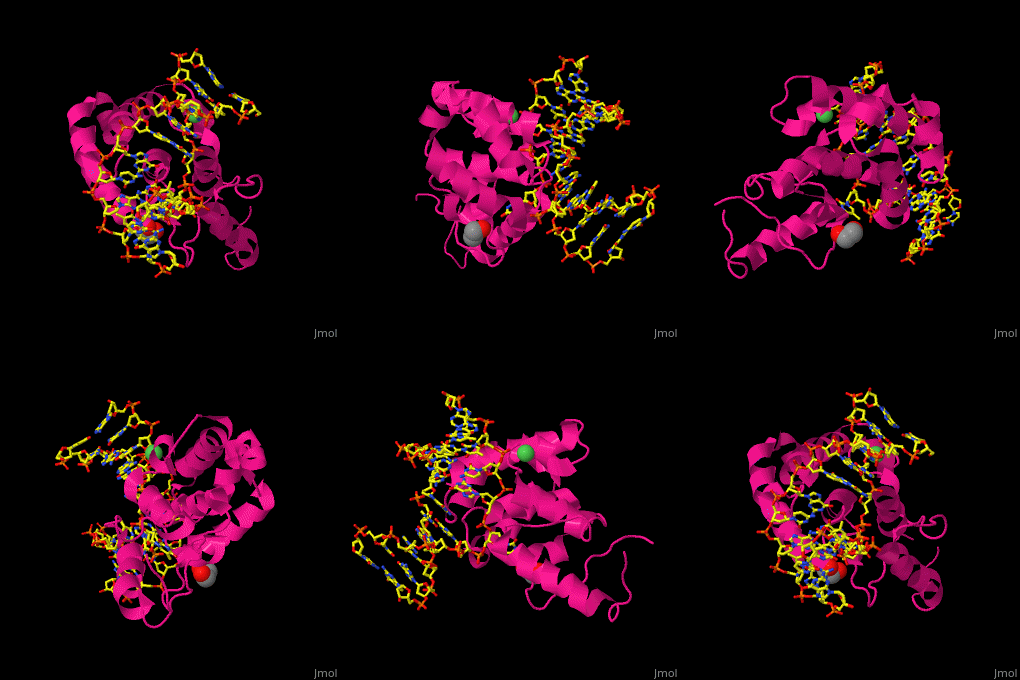
| - | <StructureSection load='4evv' size=' | + | <StructureSection load='4evv' size='350' side='right' caption='Structure of mouse MBD4 glycosylate domain complex with DNA containing mismatch, ethylene glycol and Ni+2 ion (green) (PDB code [[4evv]]).' scene='59/597003/Cv/1'> |
== Function == | == Function == | ||
| - | '''Methyl CpG binding proteins''' are called MBD1 to MBD4 and contain a methyl-CpG binding domain (MBD) which binds to methylated DNA.<br /> | + | '''Methyl CpG binding proteins''' are called MBD1 to MBD4 and contain a methyl-CpG binding domain (MBD) which binds to methylated DNA<ref>PMID:11746232</ref>.<br /> |
• '''MBD1''' is a transcription regulator. It reverts methylated cytosine bases to cytosine.<br /> | • '''MBD1''' is a transcription regulator. It reverts methylated cytosine bases to cytosine.<br /> | ||
• '''MBD2''' is part of the MeCP1 complex which contains also NuRD. MBD2 recruits histone deacetylases and DNA methyltransferases. MBD2 functions as a scaffold protein promoting repression.<br /> | • '''MBD2''' is part of the MeCP1 complex which contains also NuRD. MBD2 recruits histone deacetylases and DNA methyltransferases. MBD2 functions as a scaffold protein promoting repression.<br /> | ||
• '''MBD3''' binds to hydroxymethylated DNA.<br /> | • '''MBD3''' binds to hydroxymethylated DNA.<br /> | ||
| - | • '''MBD4''' has a G:T | + | • '''MBD4''' has a G:T mispair-specific activity.<br /> |
| - | • '''Methyl CpG binding protein 2''' (MeCP2) is present in mature nerve cells and is involved in turning off several genes. For more details see [[Methyl CpG Binding Protein 2]].<br /> | + | • '''Methyl CpG binding protein 2''' (MeCP2) is present in mature nerve cells and is involved in turning off several genes. For more details see [[Methyl CpG Binding Protein 2]] and [[Rett Syndrome Protein]].<br /> |
== Disease == | == Disease == | ||
| + | Mutations in MBD2 are involved in Rett syndrome<ref>PMID:11738862</ref>. | ||
== Relevance == | == Relevance == | ||
| + | MBD1 has a role in lung, prostate, pancreatic, colorectal cancers and promyelocytic leukemia. MBD2 has a role in lung, prostate, renal, colorectal cancers. MBD3 has a role in lung, prostate, ovarian cancers and promyelocytic leukemia. MBD4 has a role in gastric, liver and colorectal cancers. | ||
== Structural highlights == | == Structural highlights == | ||
| - | </ | + | <scene name='59/597003/Cv/3'>Thymine from the mismatched G:T pair flips out from the DNA strand and interchelates with MBD4 residues Lys and Leu</scene><ref>PMID:22740654</ref>. |
==3D structures of methyl CpG binding protein== | ==3D structures of methyl CpG binding protein== | ||
| + | [[Methyl CpG binding protein 3D structures]] | ||
| - | + | </StructureSection> | |
| - | + | ||
| - | + | ||
| - | + | ||
| - | + | ||
| - | + | ||
| - | + | ||
| - | + | ||
| - | + | ||
| - | + | ||
| - | + | ||
| - | + | ||
| - | + | ||
| - | + | ||
| - | + | ||
| - | + | ||
| - | + | ||
| - | + | ||
| - | + | ||
| - | + | ||
| - | + | ||
| - | + | ||
| - | + | ||
| - | + | ||
| - | + | ||
| - | + | ||
| - | + | ||
| - | + | ||
| - | + | ||
| - | + | ||
| - | + | ||
| - | + | ||
| - | + | ||
| - | + | ||
| - | + | ||
| - | + | ||
| - | + | ||
| - | + | ||
== References == | == References == | ||
Current revision
| |||||||||||
References
- ↑ Wade PA. Methyl CpG-binding proteins and transcriptional repression. Bioessays. 2001 Dec;23(12):1131-7. PMID:11746232 doi:http://dx.doi.org/10.1002/bies.10008
- ↑ Van den Veyver IB, Zoghbi HY. Mutations in the gene encoding methyl-CpG-binding protein 2 cause Rett syndrome. Brain Dev. 2001 Dec;23 Suppl 1:S147-51. PMID:11738862
- ↑ Hashimoto H, Zhang X, Cheng X. Excision of thymine and 5-hydroxymethyluracil by the MBD4 DNA glycosylase domain: structural basis and implications for active DNA demethylation. Nucleic Acids Res. 2012 Jun 27. PMID:22740654 doi:10.1093/nar/gks628
