P19
From Proteopedia
(Difference between revisions)
| (5 intermediate revisions not shown.) | |||
| Line 1: | Line 1: | ||
==Plant Viral Protein p19 Suppression of RNA Silencing== | ==Plant Viral Protein p19 Suppression of RNA Silencing== | ||
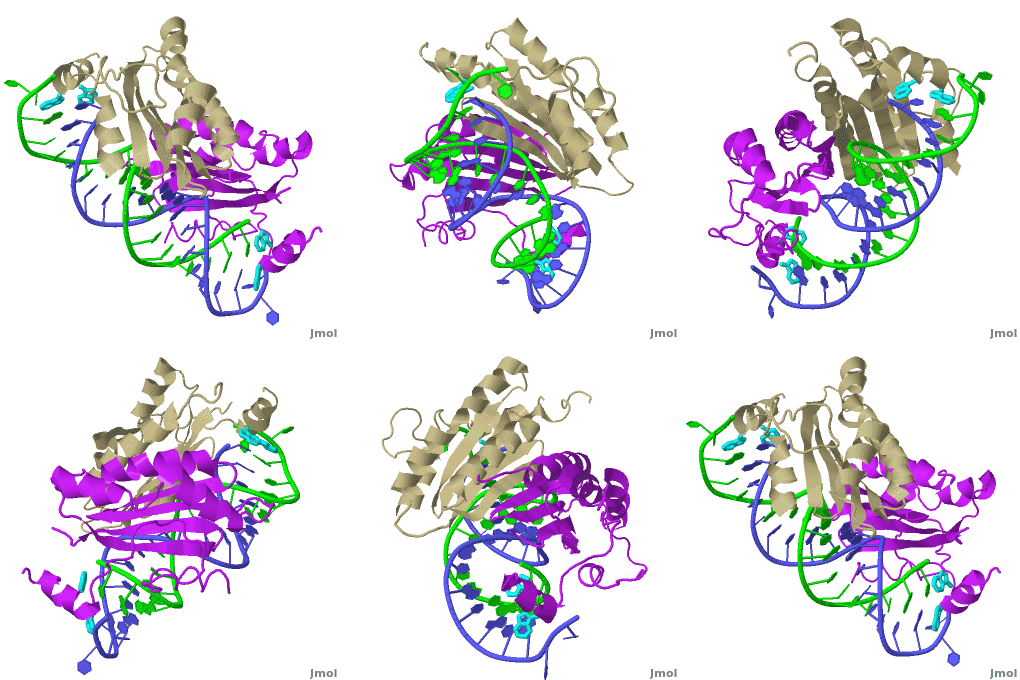
| - | <StructureSection load='' size=' | + | <StructureSection load='' size='350' side='right' caption='p19 dimer and siRNA [[1rpu]]' scene='User:Wayne_Decatur/Plant_Viral_Protein_p19_Suppression_of_RNA_Silencing/View1/2'> |
==Background== | ==Background== | ||
[http://en.wikipedia.org/wiki/RNA_Silencing RNA silencing] is a gene inactivation system in many eukaryotes that relies on tiny RNAs as the targeting molecules. One function of RNA silencing, which is also called [http://en.wikipedia.org/wiki/Post-transcriptional_gene_silencing post-transcriptional gene silencing (PTGS)] or [[RNA Interference|RNA interference]] (RNAi), is to act in surveillance against molecular parasites, such as viruses. Double-stranded RNA triggers the RNA silencing pathway and most plant viruses use a double-stranded RNA to replicate their genome. Various plant viruses have developed evasion techniques to circumvent this surveillance system. In one such evasion strategy, the plant viral protein p19 suppresses a plant's anti-viral RNA silencing response. p19 binds with high affinity to the double-stranded RNA silencing mediator, called [http://en.wikipedia.org/wiki/Small_interfering_RNA siRNA], and this binding sequesters the siRNA, preventing its participation in later steps of RNA silencing. | [http://en.wikipedia.org/wiki/RNA_Silencing RNA silencing] is a gene inactivation system in many eukaryotes that relies on tiny RNAs as the targeting molecules. One function of RNA silencing, which is also called [http://en.wikipedia.org/wiki/Post-transcriptional_gene_silencing post-transcriptional gene silencing (PTGS)] or [[RNA Interference|RNA interference]] (RNAi), is to act in surveillance against molecular parasites, such as viruses. Double-stranded RNA triggers the RNA silencing pathway and most plant viruses use a double-stranded RNA to replicate their genome. Various plant viruses have developed evasion techniques to circumvent this surveillance system. In one such evasion strategy, the plant viral protein p19 suppresses a plant's anti-viral RNA silencing response. p19 binds with high affinity to the double-stranded RNA silencing mediator, called [http://en.wikipedia.org/wiki/Small_interfering_RNA siRNA], and this binding sequesters the siRNA, preventing its participation in later steps of RNA silencing. | ||
| Line 6: | Line 6: | ||
siRNAs are generally characterized by their short length (21–26 nt), 2 nt, 3′ overhanging ends, and 5′ phosphate groups. The most efficient silencing is obtained with siRNA duplexes composed of 21-nt sense and 21-nt antisense strands, paired in a manner to have a 2-nt 3' overhang (see [http://www.rockefeller.edu/labheads/tuschl/sirna.html the Tuschl lab's guide] for designing siRNAs)<ref>Functional anatomy of siRNAs for mediating efficient RNAi in Drosophila melanogaster embryo lysate., Elbashir SM, Martinez J, Patkaniowska A, Lendeckel W, Tuschl T, EMBO J. 2001 Dec 3;20(23):6877-88. PMID:[http://www.ncbi.nlm.nih.gov/pubmed/11726523 11726523]</ref>. | siRNAs are generally characterized by their short length (21–26 nt), 2 nt, 3′ overhanging ends, and 5′ phosphate groups. The most efficient silencing is obtained with siRNA duplexes composed of 21-nt sense and 21-nt antisense strands, paired in a manner to have a 2-nt 3' overhang (see [http://www.rockefeller.edu/labheads/tuschl/sirna.html the Tuschl lab's guide] for designing siRNAs)<ref>Functional anatomy of siRNAs for mediating efficient RNAi in Drosophila melanogaster embryo lysate., Elbashir SM, Martinez J, Patkaniowska A, Lendeckel W, Tuschl T, EMBO J. 2001 Dec 3;20(23):6877-88. PMID:[http://www.ncbi.nlm.nih.gov/pubmed/11726523 11726523]</ref>. | ||
<br> | <br> | ||
| - | Structural studies <ref>Size selective recognition of siRNA by an RNA silencing suppressor., Vargason JM, Szittya G, Burgyan J, Tanaka Hall TM, Cell 2003 Dec 26;115(7):799-811. PMID:[http://www.ncbi.nlm.nih.gov/pubmed/14697199 14697199]</ref><ref>Recognition of small interfering RNA by a viral suppressor of RNA silencing., Ye K, Malinina L, Patel D J, Nature 2003 426(6968):874-878. Epub 2003 Dec 3. PMID:[http://www.ncbi.nlm.nih.gov/pubmed/14661029 14661029]</ref> have revealed how p19 from carnation and tomato viruses selectively recognizes the double-stranded siRNA. p19 from the carnation virus is presented on this page; however the results are relevant to both p19 examples as the solved structures are very similar, consistent with the high percent of identity (89%) for the homologous proteins<ref name='alignment'>[[Alignment of 1rpu vs 1r9f|Alignment of Carnation italian ringspot virus p19 (in 1rpu) vs. Tomato bushy stunt virus p19 (in 1r9f)]].</ref>. | + | Structural studies <ref>Size selective recognition of siRNA by an RNA silencing suppressor., Vargason JM, Szittya G, Burgyan J, Tanaka Hall TM, Cell 2003 Dec 26;115(7):799-811. PMID:[http://www.ncbi.nlm.nih.gov/pubmed/14697199 14697199]</ref><ref>Recognition of small interfering RNA by a viral suppressor of RNA silencing., Ye K, Malinina L, Patel D J, Nature 2003 426(6968):874-878. Epub 2003 Dec 3. PMID:[http://www.ncbi.nlm.nih.gov/pubmed/14661029 14661029]</ref> have revealed how p19 from carnation and tomato viruses selectively recognizes the double-stranded siRNA. p19 from the carnation virus is presented on this page; however the results are relevant to both p19 examples as the solved structures are very similar, consistent with the high percent of identity (89%) for the homologous proteins<ref name='alignment'>[[Alignment of 1rpu vs 1r9f|Alignment of Carnation italian ringspot virus p19 (in 1rpu) vs. Tomato bushy stunt virus p19 (in 1r9f)]].</ref>. See [[Alignment of 1rpu vs 1r9f]]. |
| - | + | ||
==Results== | ==Results== | ||
The X-ray crystal structure of <scene name='User:Wayne_Decatur/Plant_Viral_Protein_p19_Suppression_of_RNA_Silencing/Rnaprotein1rpu/3'>p19 complexed with double-stranded siRNA</scene> includes both {{User:Wayne Decatur/Template ColorKey Composition lcprotein}} and {{Template:ColorKey Composition RNA}} in the complex. {{Link Toggle FancyCartoonHighQualityView}}. | The X-ray crystal structure of <scene name='User:Wayne_Decatur/Plant_Viral_Protein_p19_Suppression_of_RNA_Silencing/Rnaprotein1rpu/3'>p19 complexed with double-stranded siRNA</scene> includes both {{User:Wayne Decatur/Template ColorKey Composition lcprotein}} and {{Template:ColorKey Composition RNA}} in the complex. {{Link Toggle FancyCartoonHighQualityView}}. | ||
| Line 72: | Line 71: | ||
Updated on {{REVISIONDAY2}}-{{MONTHNAME|{{REVISIONMONTH}}}}-{{REVISIONYEAR}} | Updated on {{REVISIONDAY2}}-{{MONTHNAME|{{REVISIONMONTH}}}}-{{REVISIONYEAR}} | ||
| - | [[1rpu]] – | + | [[1rpu]], [[6bjv]] – CirvP19 + SiRNA – Carnation italian ringspot virus<br /> |
| - | [[1rpf]], [[4jk0]], [[4kq0]] - TbsvP19 (mutant) + SiRNA | + | [[6bjh]], [[6bjg]] - CirvP19 (mutant) + SiRNA<br /> |
| - | [[3lzl]],[[3lzn]],[[3lzo]],[[3lzp]],[[3lzq]],[[3lzr]] – P19 – ''Campylobacter jejuni''<br /> | + | [[4j39]], [[4j5v]], [[4jgn]], [[4jnx]], [[4knq]], [[4ktg]] - TbsvP19 + SiRNA - Tomato bushy stunt virus <br /> |
| - | [[ | + | [[1rpf]], [[4jk0]], [[4kq0]] - TbsvP19 (mutant) + SiRNA<br /> |
| + | [[3lzl]],[[3lzn]],[[3lzo]],[[3lzp]],[[3lzq]],[[3lzr]], [[5i0w]], [[5i0v]] – P19 – ''Campylobacter jejuni''<br /> | ||
| + | [[5dof]] - TtP19 – ''Tetrahymena thermophila''<br /> | ||
| + | [[5doi]] - TtP19 + P45 <br /> | ||
| + | [[6cus]] - RsvP19 M-domain (mutant) + inositol-hexakisphosphate – Rous sarcoma virus - NMR<br /> | ||
| + | [[6cv8]], [[6cw4]] - RsvP19 M-domain (mutant) + inositol-trisphosphate – Rous sarcoma virus - NMR<br /> | ||
==Related Structures and Topics== | ==Related Structures and Topics== | ||
| Line 90: | Line 94: | ||
==Additional Literature and Resources== | ==Additional Literature and Resources== | ||
| - | *[http://www-unix.oit.umass.edu/~wdecatur/p19tutorial/ Tour of p19 bound to an siRNA] by Wayne Decatur, in an exploration-friendly interface that is adapted from Eric Martz's [http://molvis.sdsc.edu/fgij/index.htm FirstGlance in Jmol]<br> | ||
*Structural basis for RNA-silencing suppression by Tomato aspermy virus protein 2b., Chen HY, Yang J, Lin C, Yuan YA, EMBO Rep. 2008 Aug;9(8):754-60. Epub 2008 Jul 4.PMID:[http://www.ncbi.nlm.nih.gov/pubmed/18600235 18600235]<br> | *Structural basis for RNA-silencing suppression by Tomato aspermy virus protein 2b., Chen HY, Yang J, Lin C, Yuan YA, EMBO Rep. 2008 Aug;9(8):754-60. Epub 2008 Jul 4.PMID:[http://www.ncbi.nlm.nih.gov/pubmed/18600235 18600235]<br> | ||
*The structure of the flock house virus B2 protein, a viral suppressor of RNA interference, shows a novel mode of double-stranded RNA recognition., Lingel A, Simon B, Izaurralde E, Sattler M. EMBO Rep. 2005 Dec;6(12):1149-55. PMID:[http://www.ncbi.nlm.nih.gov/pubmed/16270100 16270100]<br> | *The structure of the flock house virus B2 protein, a viral suppressor of RNA interference, shows a novel mode of double-stranded RNA recognition., Lingel A, Simon B, Izaurralde E, Sattler M. EMBO Rep. 2005 Dec;6(12):1149-55. PMID:[http://www.ncbi.nlm.nih.gov/pubmed/16270100 16270100]<br> | ||
Current revision
Plant Viral Protein p19 Suppression of RNA Silencing
| |||||||||||
Proteopedia Page Contributors and Editors (what is this?)
Categories: RNA Silencing | Post-transcriptional gene silencing (PTGS) | Small Interfering RNA | Virus | Plant Virus | Double-stranded RNA (dsRNA) | SiRNA | Carnation italian ringspot virus | Burgyan, J. | Hall, T M.T. | Szittya, G. | Vargason, J M. | Protein-rna complex | Protein complex | Rna double helix | A-form helix | Rna length recognition | Rnai | Topic Page
