Apply for new accounts at the new Proteopedia. Your logins will work in both the old and new versions.
Photosystem II
From Proteopedia
| Line 1: | Line 1: | ||
| - | < | + | <StructureSection load='3a0b' size='400' frame='true' align='right' caption='Photosystem II, [[3a0b]]' scene='' > |
<!-- | <!-- | ||
| Line 11: | Line 11: | ||
==Electron Transfer== | ==Electron Transfer== | ||
| + | [[Image:Chlorophyll_a.svg.png|thumb|170px|left|structure of chlorophyll ''a'']] | ||
| + | <scene name='Photosystem_II/Chlorophyll_green/4'>Chlorophyll</scene> surround Photosystem II and capture energy from sunlight, exciting electrons. Chlorophyll are highly conjugated and absorb visible light, along with accessory light harvesting pigments such as <scene name='Photosystem_II/Betacarotene/3'>beta carotene</scene>. Beta carotene absorbs visible light of other wavelengths and also protects Photosystem II by destroying reactive oxygen species that result from this photoexcitation. Electrons are passed from chlorophyll to <scene name='Photosystem_II/Pheophytin_purple/5'>pheophytin</scene>. Pheophytin are very similar to chlorophyll except they contain 2 H<sup>+</sup> instead of a Mg<sup>2+</sup> ion. From the pheophytin, electrons transferred to <scene name='Photosystem_II/Quinone_pink/5'>plastoquinones</scene>, which are reduced. Located between each pair of quinones, an iron helps to transfer the electron. These plastoquinones eventually move to a plastoquinone pool which travels to another large protein subunit, cytochrome b <sub>6</sub>/ f. Eventually these electrons reduce NADP<sup>+</sup> to NADPH. The <scene name='Photosystem_II/Electron_pathway/3'>electron pathway</scene> through Photosystem II is shown, with '''<FONT COLOR="#F87217">beta-carotenes</FONT>''', '''<FONT COLOR="#571B7e">pheophytins</FONT>''', '''<FONT COLOR="#E42217">iron</FONT>''' and '''<FONT COLOR="#F535AA">plasotoquinones</FONT>'''. | ||
| - | |||
| - | [[Image:Chlorophyll_a.svg.png|thumb|170px|left|structure of chlorophyll ''a'']] | ||
| - | <scene name='Photosystem_II/Chlorophyll_green/4'>Chlorophyll</scene> surround Photosystem II and capture energy from sunlight, exciting electrons. Chlorophyll are highly conjugated and absorb visible light, along with accessory light harvesting pigments such as <scene name='Photosystem_II/Betacarotene/3'>beta carotene</scene>. Beta carotene absorbs visible light of other wavelengths and also protects Photosystem II by destroying reactive oxygen species that result from this photoexcitation. [[Image:b-car.svg.png|b-car.svg.png|thumb|right|400px|structure of beta carotene]] Electrons are passed from chlorophyll to <scene name='Photosystem_II/Pheophytin_purple/5'>pheophytin</scene>. Pheophytin are very similar to chlorophyll except they contain 2 H<sup>+</sup> instead of a Mg<sup>2+</sup> ion. From the pheophytin, electrons transferred to <scene name='Photosystem_II/Quinone_pink/5'>plastoquinones</scene>, which are reduced. Located between each pair of quinones, an iron helps to transfer the electron. These plastoquinones eventually move to a plastoquinone pool which travels to another large protein subunit, cytochrome b <sub>6</sub>/ f. Eventually these electrons reduce NADP<sup>+</sup> to NADPH. The <scene name='Photosystem_II/Electron_pathway/3'>electron pathway</scene> through Photosystem II is shown, with '''<FONT COLOR="#F87217">beta-carotenes</FONT>''', '''<FONT COLOR="#571B7e">pheophytins</FONT>''', '''<FONT COLOR="#E42217">iron</FONT>''' and '''<FONT COLOR="#F535AA">plasotoquinones</FONT>'''. | ||
| - | [[Image:plastoquinone.jpg|thumb|300px|right|reduced plastoquinone]] | ||
==Oxygen Evolution== | ==Oxygen Evolution== | ||
Another important facet of Photosystem II is its ability to oxidize water to oxygen with its <scene name='Photosystem_II/Oxygen_evolving_centers/11'>oxygen evolving centers</scene>. These centers are <scene name='Photosystem_II/Single_oxygen_evolving/1'>cubane-like</scene> structures with 3 '''<FONT COLOR="#8D38C9">manganese</FONT>''', 4 '''<FONT COLOR="#C11B17">oxygen</FONT>''' and a '''<FONT COLOR="#59E817">calcium</FONT>''' linked to a fourth manganese<ref>PMID: 14764885</ref>. Oxidation of water leaves 2 H <sup>+</sup> on the lumenal side of the membrane, helping to establish the proton gradient essential for ATP synthesis in the CF<sub>1</sub>CF<sub>0</sub>-ATP sythase protein. | Another important facet of Photosystem II is its ability to oxidize water to oxygen with its <scene name='Photosystem_II/Oxygen_evolving_centers/11'>oxygen evolving centers</scene>. These centers are <scene name='Photosystem_II/Single_oxygen_evolving/1'>cubane-like</scene> structures with 3 '''<FONT COLOR="#8D38C9">manganese</FONT>''', 4 '''<FONT COLOR="#C11B17">oxygen</FONT>''' and a '''<FONT COLOR="#59E817">calcium</FONT>''' linked to a fourth manganese<ref>PMID: 14764885</ref>. Oxidation of water leaves 2 H <sup>+</sup> on the lumenal side of the membrane, helping to establish the proton gradient essential for ATP synthesis in the CF<sub>1</sub>CF<sub>0</sub>-ATP sythase protein. | ||
| - | + | [[Image:b-car.svg.png|b-car.svg.png|thumb|left|400px|structure of beta carotene]] | |
| + | [[Image:plastoquinone.jpg|thumb|300px|left|reduced plastoquinone]] | ||
| + | </StructureSection> | ||
==3D structures of photosystem II== | ==3D structures of photosystem II== | ||
Revision as of 11:54, 20 February 2013
| |||||||||||
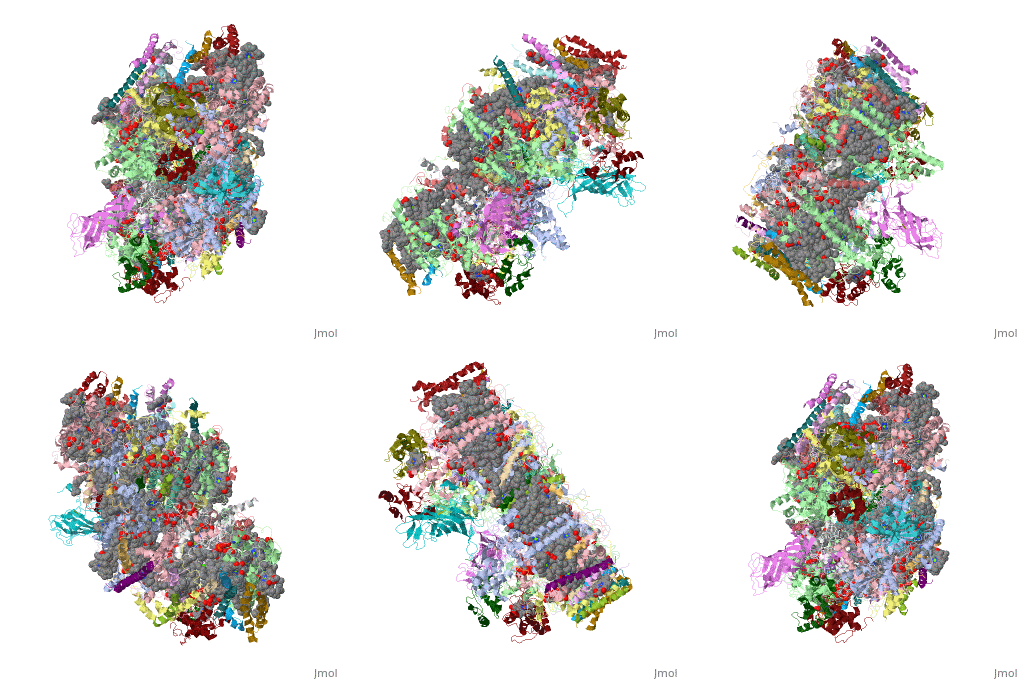


3D structures of photosystem II
Updated June 2012
3arc, 3a0b, 3a0h – PSII – Thermosynechococcus vulcanos
3prq, 3prr - TePSII + terbutryn – Thermosynechococcus elongatus
3kzi, 3bz1, 3bz2, 2axt, 1w5c, 1s5l, 1izl, 1ilx, 1fe1 – TePSII
2y6x – TePSII PSB27 protein
2kvo – SyPSII reaction center PSB28 protein – Synechocystis – NMR
2kmf, 2knd - SyPSII reaction center PSB27 subunit – NMR
2vu4, 1vyk – spPSII PSBP subunit – spinach
1nze - spPSII PSBQ subunit
1v2b - PSII PSBP subunit – tobacco
1fc6, 1fc7, 1fc9, 1fcf – PSII C terminal processing protease – Scenedesmus obliquus
Additional Resources
For additional information, see: Photosynthesis
References
- ↑ Loll B, Kern J, Saenger W, Zouni A, Biesiadka J. Towards complete cofactor arrangement in the 3.0 A resolution structure of photosystem II. Nature. 2005 Dec 15;438(7070):1040-4. PMID:16355230 doi:http://dx.doi.org/10.1038/nature04224
- ↑ Ferreira KN, Iverson TM, Maghlaoui K, Barber J, Iwata S. Architecture of the photosynthetic oxygen-evolving center. Science. 2004 Mar 19;303(5665):1831-8. Epub 2004 Feb 5. PMID:14764885 doi:http://dx.doi.org/10.1126/science.1093087
- ↑ Ferreira KN, Iverson TM, Maghlaoui K, Barber J, Iwata S. Architecture of the photosynthetic oxygen-evolving center. Science. 2004 Mar 19;303(5665):1831-8. Epub 2004 Feb 5. PMID:14764885 doi:http://dx.doi.org/10.1126/science.1093087
Proteopedia Page Contributors and Editors (what is this?)
Emily Forschler, Michal Harel, Ilan Samish, Alexander Berchansky, Eric Martz, Jaime Prilusky, Eran Hodis, Joel L. Sussman, David Canner, Karl Oberholser

