User:Erin May/Sandbox 1
From Proteopedia
| Line 6: | Line 6: | ||
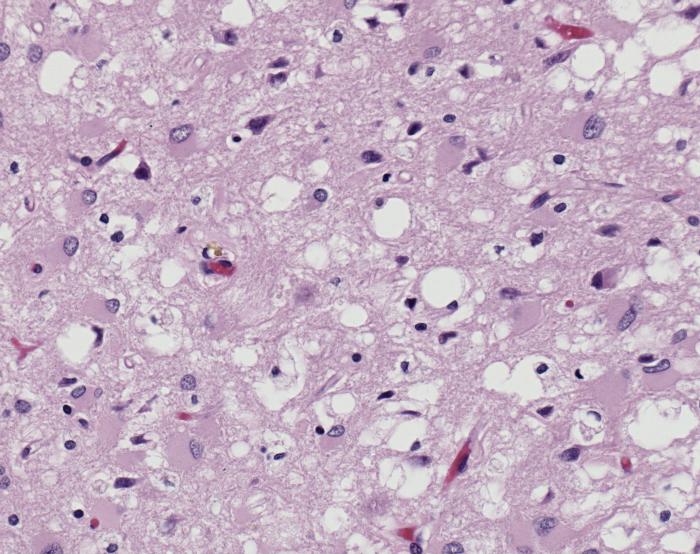
[[Image:http://www.proteopedia.org/wiki/index.php/Image:10131_lores.jpg|left|120px|thumb|frame|Pictomicrograph of Creutzfeldt-Jakob positive brain tissue|Caption: Holes in this sponge like brain tissue result from pockets of prion aggregation <ref>[http://phil.cdc.gov/PHIL_Images/10131/10131_lores.jpg Image of Creutzfeldt-Jakob positive brain tissue] was obtained from The CDC's Public Health Image Library.</ref>]] | [[Image:http://www.proteopedia.org/wiki/index.php/Image:10131_lores.jpg|left|120px|thumb|frame|Pictomicrograph of Creutzfeldt-Jakob positive brain tissue|Caption: Holes in this sponge like brain tissue result from pockets of prion aggregation <ref>[http://phil.cdc.gov/PHIL_Images/10131/10131_lores.jpg Image of Creutzfeldt-Jakob positive brain tissue] was obtained from The CDC's Public Health Image Library.</ref>]] | ||
| - | [http://en.wikipedia.org/wiki/Prion Prions] are infectious or genetic misfolded proteins which act as templates upon which properly folded prion protein monomers can aggregate. Prions contain no nucleic acid such as other infectoius molecules or organisms. Human Prion Protein or Major Prion protein, exists as a normal constituent of human cells, found mostly in the brain<ref>Centers for Disease Control and Prevention</ref> and is called | + | [http://en.wikipedia.org/wiki/Prion Prions] are infectious or genetic misfolded proteins which act as templates upon which properly folded prion protein monomers can aggregate. Prions contain no nucleic acid such as other infectoius molecules or organisms. Human Prion Protein or Major Prion protein, exists as a normal constituent of human cells, found mostly in the brain<ref>Centers for Disease Control and Prevention</ref> and is called PrP<sup>C.<ref name="Prusiner">PMID:9811807</ref> PrP<sup>C is composed of mostly helix whereas the infectious form, PrP<sup>Sc, is composed of high percentage beta sheets.<ref name="Prusiner">PMID:9811807</ref> |
The diseases prions confer are neurodegenerative disorders which result from the large scale aggregation of these proteins. For more information about the infections related to prions see [http://en.wikipedia.org/wiki/Transmissible_spongiform_encephalopathy Transmissible spongiform encephalopathy at Wikipedia]. | The diseases prions confer are neurodegenerative disorders which result from the large scale aggregation of these proteins. For more information about the infections related to prions see [http://en.wikipedia.org/wiki/Transmissible_spongiform_encephalopathy Transmissible spongiform encephalopathy at Wikipedia]. | ||
| Line 14: | Line 14: | ||
== Unfolding Mechanism == | == Unfolding Mechanism == | ||
Currently, the mechanism by which a template prion unfolds a the helices of a properly folded prion protein is unknown. Specific residues have been shown to either confer resistance or lend themselves to this unfolding. | Currently, the mechanism by which a template prion unfolds a the helices of a properly folded prion protein is unknown. Specific residues have been shown to either confer resistance or lend themselves to this unfolding. | ||
| - | The following | ||
| - | === | + | ===PrP<sup>C natural monomer=== |
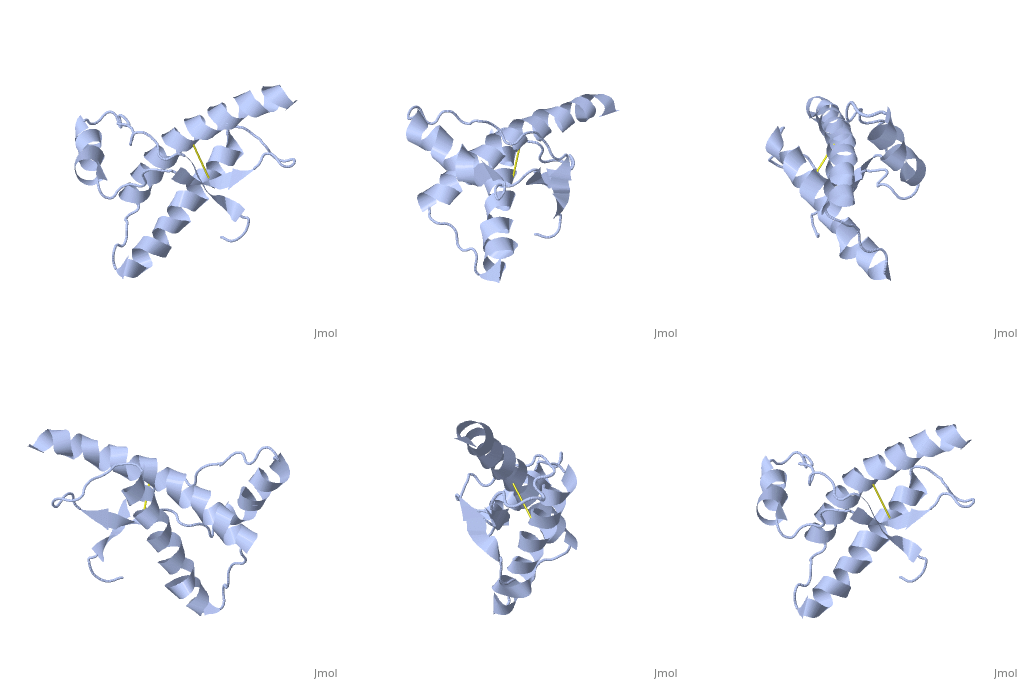
<StructureSection load='1qlx' size='300' side='left' caption='Major Prion Protein [[1qlx]]' scene=''> | <StructureSection load='1qlx' size='300' side='left' caption='Major Prion Protein [[1qlx]]' scene=''> | ||
Revision as of 04:52, 27 November 2012
Contents |
Prions as a disease causing agent

Prions are infectious or genetic misfolded proteins which act as templates upon which properly folded prion protein monomers can aggregate. Prions contain no nucleic acid such as other infectoius molecules or organisms. Human Prion Protein or Major Prion protein, exists as a normal constituent of human cells, found mostly in the brain[2] and is called PrPC.[3] PrPC is composed of mostly helix whereas the infectious form, PrPSc, is composed of high percentage beta sheets.[3]
The diseases prions confer are neurodegenerative disorders which result from the large scale aggregation of these proteins. For more information about the infections related to prions see Transmissible spongiform encephalopathy at Wikipedia.
Unfolding Mechanism
Currently, the mechanism by which a template prion unfolds a the helices of a properly folded prion protein is unknown. Specific residues have been shown to either confer resistance or lend themselves to this unfolding.
PrPC natural monomer
| |||||||||||
Dimer and Full aggregate forms
Reference List