Overview
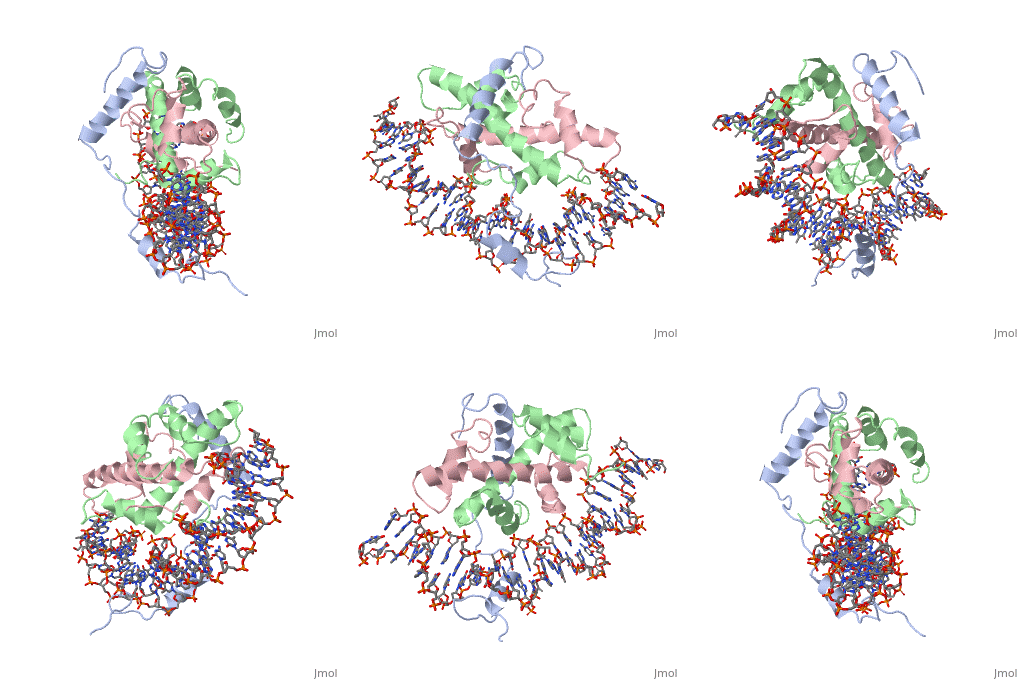
A transcription factor (TF) is a protein that binds to specific DNA sequences and can either repress or activate the transcription of a gene. TFs have a diverse family of proteins and normally exist in a multisubunit complex. NF-Y is a transcription factor involved in histone post-translational modifications (PTMs) [1]. In plants, the NF-Y transcription factors regulate and respond to many physiological responses. NF-Y subunits are closely related to core histones. A histone is a conserved protein that wraps 146 nucleotides of DNA into the basic unit of chromatin, the nucleosome [2]. Histone-fold Domains (HFDs) are required for the tertiary structure of histones and non-sequence specific contacts with DNA[2].
Protein Structure
The NF-Y transcription factor consists of ,
, and subunits. NF-YA subunit contains two α-helices, NF-YB subunit contains four α-helices and two β-sheets, and NF-YC subunit contains three α-helices and two β-sheets. The NF-YB and NF-YC subunits each contain a histone fold motif and form a NF-YB/NF-YC histone folding domain (HFD) dimer[3]. The composition of mostly α-helices gives the protein flexibility. One of the two α helices of the NF-YA subunit, the N terminal , interacts with NF-YB/NF-YC heterodimer resulting in a heterotrimer.
The NF-Y heterotrimer is stabilized by ionic interactions, interactions between the backbone atoms of residues, and hydrophobic residues. Stabilizing ionic interactions occur between Asn239(NF-YA) with Asp109(NF-YC) and Asp112(NF-YC)[1]. Residue backbone interactions occur between Leu123(NF-YB) with Phe113(NF-YC), Arg245(NF-YA) with Glu98(NF-YB) and Glu101(NF-YB), Arg249(NF-YA) with Glu90(NF-YB), and Arg250(NF-YA) with Asp116(NF-YC)[1]. that contribute to the stabilization of the NF-Y heterotrimer are only located at NF-YA and NF-YB subunits at residues Ile246(NF-YA), Phe94(NF-YB), and Ile115(NF-YB)[1](Hydrophobic Polar). The NF-Y heterotrimer is also stabilized by the segment through intramolecular interactions of NF-YA residues on the main chain and side chain. Along with stabilization, the A1A2 linker provides the flexibility needed to direct the NF-YA chain toward DNA[1].
Protein Function
The post-translational modifications (PTMs) that NF-Y transcription factor is associated with aid in identifying regions of DNA that are destined to be transcribed. NF-Y is responsible for recruiting enzymes responsible for transcription (like RNA Polymerase II), and enzymes involved in acetylations on active promoters, suggesting that NF-Y is involved in switch-modifications [2]. Furthermore, NF-Y is a sequence-specific TF. It is possible that NF-Y and other sequence-specific TFs determine histone modifications on promoters[1].
NF-Y is regulated by redox mechanisms[4]. The regulated subunit (NF-YB) has three conserved cysteines in its A2 helix: , , and ; which sense the cellular redox potential and allow heterodimerization under reduced conditions. In oxidized conditions, NF-YB forms heterodimers in the cytoplasm which hinders CCAAT-binding and transcriptional activation[4].
The NF-Y gene can be deferentially spliced to provide different isoforms of the protein. [2]. For example, NF-YA has two isoforms, which differ in the amount of amino acids in the glutamine (Q)-rich activation domain[2]. The purpose of these isoforms has yet to be seen, however studies suggest that certain gene expression is dependent on which isoform is present at a time[2]. Another study showed that NF-YA and NF-YB is required for embryonic stem cell (ESC) viability[2].
DNA Interaction
NF-Y interacts with DNA in several ways; one particular way is by using the C terminal of the NF-YA subunit inserts deep into the minor groove of DNA. NF-YA A2 helix binds to the box and causes the minor groove to widen at the CCAAT box[1]. residues interacting with the CCAAT box prevent G bases due to steric reasons, and these residues perform specific interactions that link the NF-Y/DNA complex. Van der Waals and provide the stabilization of the NF-Y/DNA complex due to the highly basic surface of the NF-YB/NF-YC HFD dimer and negatively charged DNA[1](Hydrophobic Polar). Interaction between NF-Y and DNA can be blocked by drugs that bind to the minor groove.
References
- ↑ 1.0 1.1 1.2 1.3 1.4 1.5 1.6 1.7 Nardini M, Gnesutta N, Donati G, Gatta R, Forni C, Fossati A, Vonrhein C, Moras D, Romier C, Bolognesi M, Mantovani R. Sequence-Specific Transcription Factor NF-Y Displays Histone-like DNA Binding and H2B-like Ubiquitination. Cell. 2013 Jan 17;152(1-2):132-43. doi: 10.1016/j.cell.2012.11.047. PMID:23332751 doi:http://dx.doi.org/10.1016/j.cell.2012.11.047
- ↑ 2.0 2.1 2.2 2.3 2.4 2.5 2.6 Dolfini D, Gatta R, Mantovani R. NF-Y and the transcriptional activation of CCAAT promoters. Crit Rev Biochem Mol Biol. 2012 Jan-Feb;47(1):29-49. doi:, 10.3109/10409238.2011.628970. Epub 2011 Nov 3. PMID:22050321 doi:http://dx.doi.org/10.3109/10409238.2011.628970
- ↑ Xiao J, Zhou Y, Lai H, Lei S, Chi LH, Mo X. Transcription Factor NF-Y Is a Functional Regulator of the Transcription of Core Clock Gene Bmal1. J Biol Chem. 2013 Nov 1;288(44):31930-6. doi: 10.1074/jbc.M113.507038. Epub 2013 , Sep 12. PMID:24030830 doi:http://dx.doi.org/10.1074/jbc.M113.507038
- ↑ 4.0 4.1 Thon M, Al Abdallah Q, Hortschansky P, Scharf DH, Eisendle M, Haas H, Brakhage AA. The CCAAT-binding complex coordinates the oxidative stress response in eukaryotes. Nucleic Acids Res. 2010 Mar;38(4):1098-113. doi: 10.1093/nar/gkp1091. Epub 2009, Dec 3. PMID:19965775 doi:http://dx.doi.org/10.1093/nar/gkp1091