This old version of Proteopedia is provided for student assignments while the new version is undergoing repairs. Content and edits done in this old version of Proteopedia after March 1, 2026 will eventually be lost when it is retired in about June of 2026.
Apply for new accounts at the new Proteopedia. Your logins will work in both the old and new versions.
Proton Channels
From Proteopedia
m (polishing) |
|||
| Line 3: | Line 3: | ||
See [[:Category:Proton_channel]] for a list of all proton channel structures. | See [[:Category:Proton_channel]] for a list of all proton channel structures. | ||
| - | In January, 2008, crystallographic and NMR structures were published side by side in ''Nature'' for the transmembrane domains of the M2 protein: [[3bkd]] | + | In January, 2008, crystallographic and NMR structures were published side by side in ''Nature'' for the transmembrane domains of the M2 protein: [[3bkd]] to [[2rlf]]. The former appeared to be in an open conformation blocked by amantadine, while the latter appeared to be in a closed conformation stabilized by rimantadine. (Neither drug is shown in the morph at right.) |
| - | <applet load='3bkd2rlf.pdb' size='400' frame='true' align='right' scene='Proton_Channels/Cartoon/2' caption='Linear interpolation morph from | + | <!-- THESE LINKS DO NOT WORK IN THE CAPTION; NEITHER DOES THE FORM [[3bkd]] |
| + | caption='Linear interpolation morph from [http://proteopedia.org/wiki/index.php/3bkd 3bkd] to [http://proteopedia.org/wiki/index.php/2rlf 2rlf model 1] ' /> | ||
| + | --> | ||
| + | <applet load='3bkd2rlf.pdb' size='400' frame='true' align='right' scene='Proton_Channels/Cartoon/2' caption='Linear interpolation morph from 3bkd to model 1 of 2rlf. ' /> | ||
At right is a [[Morphs|linear-interpolation morph]] between 3BKD and 2RLF, showing the proposed opening and closing of this channel. | At right is a [[Morphs|linear-interpolation morph]] between 3BKD and 2RLF, showing the proposed opening and closing of this channel. | ||
| - | In addition to watching the animation as alpha-helical ribbons, it is useful to watch it <scene name='Proton_Channels/Spacefilled/1'>spacefilled</scene>. Be sure to rotate the molecule to watch the animation from different perspectives! | + | In addition to watching the animation as alpha-helical ribbons, it is useful to watch it <scene name='Proton_Channels/Spacefilled/1'>spacefilled</scene>. '''Be sure to rotate the molecule with your mouse to watch the animation from different perspectives!''' |
<scene name='Proton_Channels/Gating/1'>His37 and Trp41</scene> are believed to be crucial for pH-dependent gating. | <scene name='Proton_Channels/Gating/1'>His37 and Trp41</scene> are believed to be crucial for pH-dependent gating. | ||
| - | (The collapse and re-expansion of their sidechains is due to the [[Morphs|linear interpolation method]].) Here are His and Trp <scene name='Proton_Channels/Gating/2'>spacefilled</scene>. | + | (The apparent collapse and re-expansion of their sidechains is an artifact due to the [[Morphs|linear interpolation method of morphing]].) Here are His and Trp <scene name='Proton_Channels/Gating/2'>spacefilled</scene>. |
Revision as of 17:02, 23 March 2008
The M2 protein of influenza A virus is a proton channel. Its function is essential for productive infection by the virus.
See Category:Proton_channel for a list of all proton channel structures.
In January, 2008, crystallographic and NMR structures were published side by side in Nature for the transmembrane domains of the M2 protein: 3bkd to 2rlf. The former appeared to be in an open conformation blocked by amantadine, while the latter appeared to be in a closed conformation stabilized by rimantadine. (Neither drug is shown in the morph at right.)
|
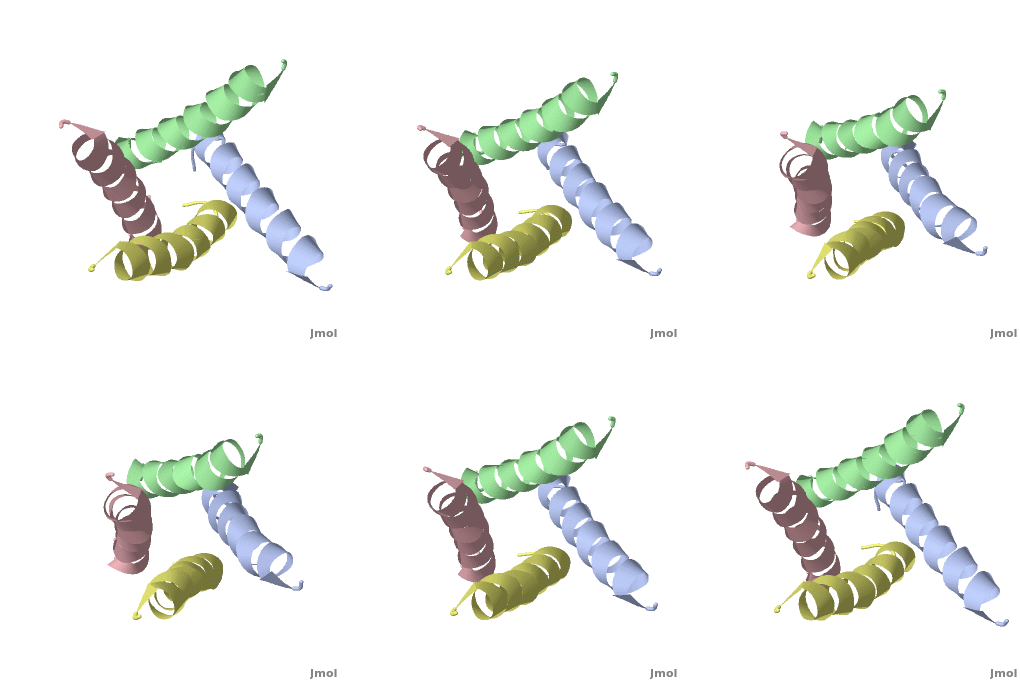
At right is a linear-interpolation morph between 3BKD and 2RLF, showing the proposed opening and closing of this channel.
In addition to watching the animation as alpha-helical ribbons, it is useful to watch it . Be sure to rotate the molecule with your mouse to watch the animation from different perspectives!
are believed to be crucial for pH-dependent gating. (The apparent collapse and re-expansion of their sidechains is an artifact due to the linear interpolation method of morphing.) Here are His and Trp .
Proteopedia Page Contributors and Editors (what is this?)
Eric Martz, Eran Hodis, David Canner, Michal Harel, Joel L. Sussman, Alexander Berchansky, Jaime Prilusky
