This old version of Proteopedia is provided for student assignments while the new version is undergoing repairs. Content and edits done in this old version of Proteopedia after March 1, 2026 will eventually be lost when it is retired in about June of 2026.
Apply for new accounts at the new Proteopedia. Your logins will work in both the old and new versions.
Molecular Playground/Insulin
From Proteopedia
| Line 7: | Line 7: | ||
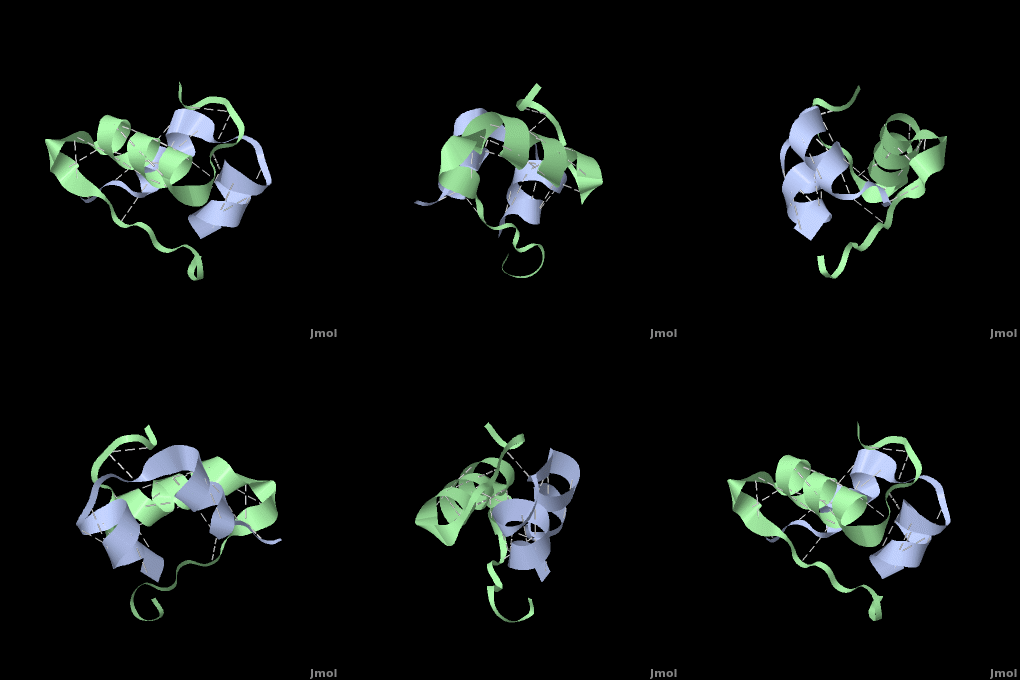
Insulin is able to pair-up with itself and form a dimer by forming hydrogen bonds between the ends of two B-chains. These <scene name='User:Whitney_Stoppel/sandbox1/Insulin_dimer/2'>hydrogen bonds</scene> are shown above in white. Then, 3 dimers can come together in the presence of zinc ions and form a hexamer. Insulin is stored in the <scene name='User:Whitney_Stoppel/sandbox1/Insulin_hexamer/4'>hexameric form</scene> in the body. This <scene name='User:Whitney_Stoppel/sandbox1/Insulin_ph7/2'>scene highlights</scene> the hydrophobic (gray) and polar (purple) parts of an insulin monomer at a pH of 7. It is believed that the hydrophobic sections on the B-chain cause insulin aggregation which initially caused problems in the manufacture and storage of insulin for [[Pharmaceutical_Drugs#Treatments|pharmaceutical use]]. | Insulin is able to pair-up with itself and form a dimer by forming hydrogen bonds between the ends of two B-chains. These <scene name='User:Whitney_Stoppel/sandbox1/Insulin_dimer/2'>hydrogen bonds</scene> are shown above in white. Then, 3 dimers can come together in the presence of zinc ions and form a hexamer. Insulin is stored in the <scene name='User:Whitney_Stoppel/sandbox1/Insulin_hexamer/4'>hexameric form</scene> in the body. This <scene name='User:Whitney_Stoppel/sandbox1/Insulin_ph7/2'>scene highlights</scene> the hydrophobic (gray) and polar (purple) parts of an insulin monomer at a pH of 7. It is believed that the hydrophobic sections on the B-chain cause insulin aggregation which initially caused problems in the manufacture and storage of insulin for [[Pharmaceutical_Drugs#Treatments|pharmaceutical use]]. | ||
| - | </StructureSection> For additional details see [[Insulin Structure & Function]]. | + | </StructureSection> For additional details see<br /> |
| + | [[Insulin Structure & Function]]<br /> | ||
| + | [[Diabetes & Hypoglycemia]]. | ||
Revision as of 11:48, 1 February 2016
One of the CBI Molecules being studied in the University of Massachusetts Amherst Chemistry-Biology Interface Program at UMass Amherst in the Roberts Research Group and on display at the Molecular Playground.
| |||||||||||

Insulin Structure & Function
Diabetes & Hypoglycemia.
3D structures of Insulin (Updated on 01-February-2016)
Additional Resources
For additional information, see: Diabetes & Hypoglycemia
Proteopedia Page Contributors and Editors (what is this?)
Michal Harel, Joel L. Sussman, Shelly Livne, Karsten Theis, David Canner, Whitney Stoppel, Alexander Berchansky, Yael Shwartz, Lynmarie K Thompson, Jaime Prilusky
