This old version of Proteopedia is provided for student assignments while the new version is undergoing repairs. Content and edits done in this old version of Proteopedia after March 1, 2026 will eventually be lost when it is retired in about June of 2026.
Apply for new accounts at the new Proteopedia. Your logins will work in both the old and new versions.
1e9z
From Proteopedia
(Difference between revisions)
| Line 3: | Line 3: | ||
<StructureSection load='1e9z' size='340' side='right'caption='[[1e9z]], [[Resolution|resolution]] 3.00Å' scene=''> | <StructureSection load='1e9z' size='340' side='right'caption='[[1e9z]], [[Resolution|resolution]] 3.00Å' scene=''> | ||
== Structural highlights == | == Structural highlights == | ||
| - | <table><tr><td colspan='2'>[[1e9z]] is a 2 chain structure with sequence from [https://en.wikipedia.org/wiki/ | + | <table><tr><td colspan='2'>[[1e9z]] is a 2 chain structure with sequence from [https://en.wikipedia.org/wiki/Helicobacter_pylori Helicobacter pylori]. Full crystallographic information is available from [http://oca.weizmann.ac.il/oca-bin/ocashort?id=1E9Z OCA]. For a <b>guided tour on the structure components</b> use [https://proteopedia.org/fgij/fg.htm?mol=1E9Z FirstGlance]. <br> |
| - | </td></tr><tr id=' | + | </td></tr><tr id='method'><td class="sblockLbl"><b>[[Empirical_models|Method:]]</b></td><td class="sblockDat" id="methodDat">X-ray diffraction, [[Resolution|Resolution]] 3Å</td></tr> |
| - | <tr id=' | + | <tr id='ligand'><td class="sblockLbl"><b>[[Ligand|Ligands:]]</b></td><td class="sblockDat" id="ligandDat"><scene name='pdbligand=KCX:LYSINE+NZ-CARBOXYLIC+ACID'>KCX</scene>, <scene name='pdbligand=NI:NICKEL+(II)+ION'>NI</scene></td></tr> |
| - | + | ||
| - | + | ||
<tr id='resources'><td class="sblockLbl"><b>Resources:</b></td><td class="sblockDat"><span class='plainlinks'>[https://proteopedia.org/fgij/fg.htm?mol=1e9z FirstGlance], [http://oca.weizmann.ac.il/oca-bin/ocaids?id=1e9z OCA], [https://pdbe.org/1e9z PDBe], [https://www.rcsb.org/pdb/explore.do?structureId=1e9z RCSB], [https://www.ebi.ac.uk/pdbsum/1e9z PDBsum], [https://prosat.h-its.org/prosat/prosatexe?pdbcode=1e9z ProSAT]</span></td></tr> | <tr id='resources'><td class="sblockLbl"><b>Resources:</b></td><td class="sblockDat"><span class='plainlinks'>[https://proteopedia.org/fgij/fg.htm?mol=1e9z FirstGlance], [http://oca.weizmann.ac.il/oca-bin/ocaids?id=1e9z OCA], [https://pdbe.org/1e9z PDBe], [https://www.rcsb.org/pdb/explore.do?structureId=1e9z RCSB], [https://www.ebi.ac.uk/pdbsum/1e9z PDBsum], [https://prosat.h-its.org/prosat/prosatexe?pdbcode=1e9z ProSAT]</span></td></tr> | ||
</table> | </table> | ||
== Function == | == Function == | ||
| - | + | [https://www.uniprot.org/uniprot/URE23_HELPY URE23_HELPY] Ammonia produced by ureolysis increases the gastric pH thereby providing an environment permissive for colonization of the stomach.<ref>PMID:8039935</ref> | |
== Evolutionary Conservation == | == Evolutionary Conservation == | ||
[[Image:Consurf_key_small.gif|200px|right]] | [[Image:Consurf_key_small.gif|200px|right]] | ||
| Line 39: | Line 37: | ||
__TOC__ | __TOC__ | ||
</StructureSection> | </StructureSection> | ||
| - | [[Category: | + | [[Category: Helicobacter pylori]] |
[[Category: Large Structures]] | [[Category: Large Structures]] | ||
| - | + | [[Category: Ha N-C]] | |
| - | [[Category: Ha | + | [[Category: Oh B-H]] |
| - | [[Category: Oh | + | [[Category: Oh S-T]] |
| - | [[Category: Oh | + | |
| - | + | ||
Current revision
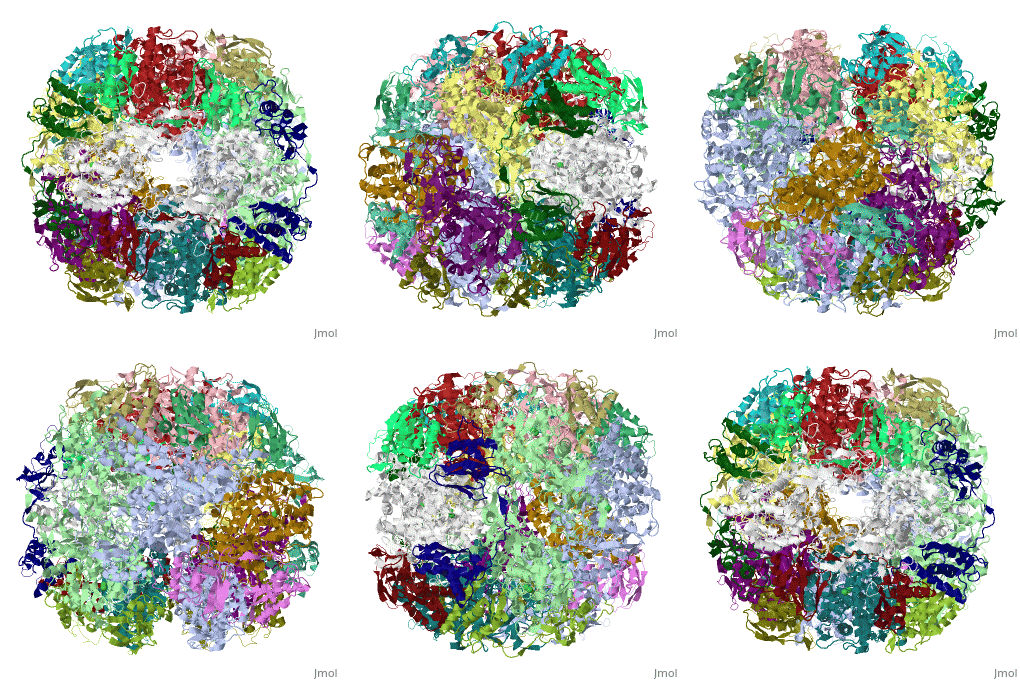
Crystal structure of Helicobacter pylori urease
| |||||||||||