This old version of Proteopedia is provided for student assignments while the new version is undergoing repairs. Content and edits done in this old version of Proteopedia after March 1, 2026 will eventually be lost when it is retired in about June of 2026.
Apply for new accounts at the new Proteopedia. Your logins will work in both the old and new versions.
Chaperones
From Proteopedia
(Difference between revisions)
| Line 12: | Line 12: | ||
== Structural highlights == | == Structural highlights == | ||
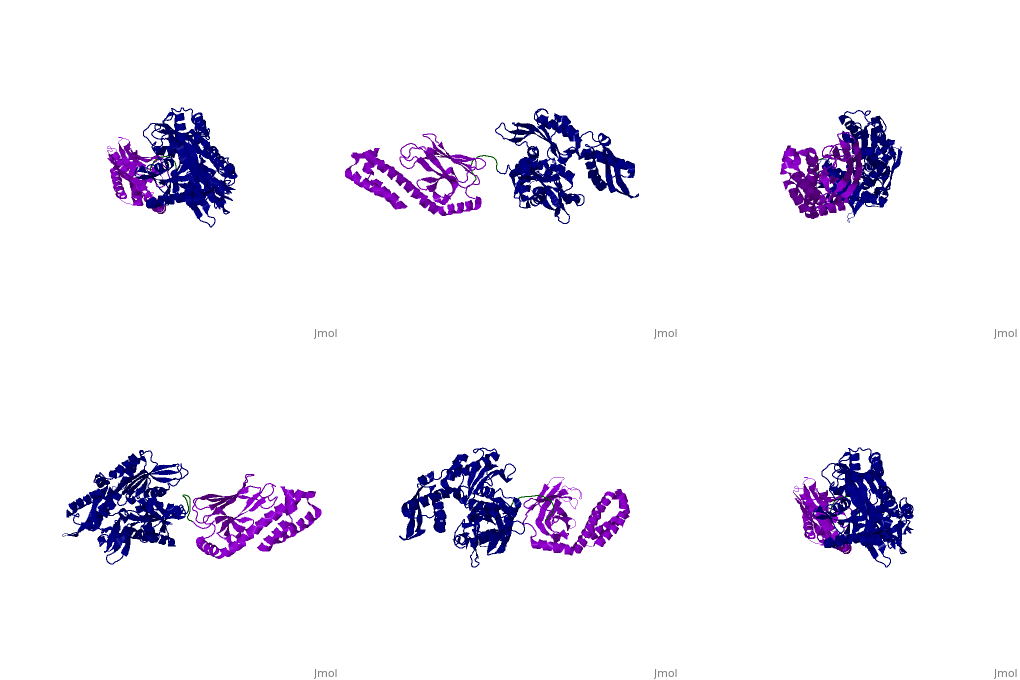
| - | Structurally, <scene name='59/591341/Structural_organization/2'>Hsp70</scene> have a N-terminal <scene name='59/591341/Nbd_hsp70/ | + | Structurally, <scene name='59/591341/Structural_organization/2'>Hsp70</scene> have a N-terminal <scene name='59/591341/Nbd_hsp70/7'>ATPase domain</scene> followed by a <scene name='59/591341/Substrate_binding_domain/1'>substrate binding domain with elongated C-terminal</scene>. These domains <scene name='59/591341/Transition1/2'>allosterically regulate</scene> the hsp70 functioning. <scene name='59/591341/4jn4/2'>4JN4</scene> is a representative example of a chaperone system in complex with ADP. In the 2D figure given below, panel A indicates the various folded (green) and unfolded (red)regions in Hsp70. Panel B shows the structural organization of Hsp 70 indicating its various domains. ATP binding and hydrolysis regulates the affinity for substrate proteins which thereafter enhances ATP hydrolysis. |
[[Image:1-s2.0-S0301462209000520-gr1.jpg|left|500px|thumb|Structural organization of Hsp70]] | [[Image:1-s2.0-S0301462209000520-gr1.jpg|left|500px|thumb|Structural organization of Hsp70]] | ||
</StructureSection> | </StructureSection> | ||
Revision as of 11:37, 19 June 2014
| |||||||||||
References
- ↑ Kim YE, Hipp MS, Bracher A, Hayer-Hartl M, Hartl FU. Molecular chaperone functions in protein folding and proteostasis. Annu Rev Biochem. 2013;82:323-55. doi: 10.1146/annurev-biochem-060208-092442. PMID:23746257 doi:http://dx.doi.org/10.1146/annurev-biochem-060208-092442
- ↑ Ellis J. Proteins as molecular chaperones. Nature. 1987 Jul 30-Aug 5;328(6129):378-9. PMID:3112578 doi:http://dx.doi.org/10.1038/328378a0
- ↑ Deshaies RJ, Koch BD, Werner-Washburne M, Craig EA, Schekman R. A subfamily of stress proteins facilitates translocation of secretory and mitochondrial precursor polypeptides. Nature. 1988 Apr 28;332(6167):800-5. PMID:3282178 doi:http://dx.doi.org/10.1038/332800a0
- ↑ Halperin L, Jung J, Michalak M. The many functions of the endoplasmic reticulum chaperones and folding enzymes. IUBMB Life. 2014 May 19. doi: 10.1002/iub.1272. PMID:24839203 doi:http://dx.doi.org/10.1002/iub.1272
- ↑ Gurard-Levin ZA, Quivy JP, Almouzni G. Histone chaperones: assisting histone traffic and nucleosome dynamics. Annu Rev Biochem. 2014 Jun 2;83:487-517. doi:, 10.1146/annurev-biochem-060713-035536. PMID:24905786 doi:http://dx.doi.org/10.1146/annurev-biochem-060713-035536
- ↑ Matambo TS, Odunuga OO, Boshoff A, Blatch GL. Overproduction, purification, and characterization of the Plasmodium falciparum heat shock protein 70. Protein Expr Purif. 2004 Feb;33(2):214-22. PMID:14711509
- ↑ Misra G, Ramachandran R. Hsp70-1 from Plasmodium falciparum: protein stability, domain analysis and chaperone activity. Biophys Chem. 2009 Jun;142(1-3):55-64. doi: 10.1016/j.bpc.2009.03.006. Epub 2009 , Mar 16. PMID:19339102 doi:http://dx.doi.org/10.1016/j.bpc.2009.03.006
- ↑ Kim YE, Hipp MS, Bracher A, Hayer-Hartl M, Hartl FU. Molecular chaperone functions in protein folding and proteostasis. Annu Rev Biochem. 2013;82:323-55. doi: 10.1146/annurev-biochem-060208-092442. PMID:23746257 doi:http://dx.doi.org/10.1146/annurev-biochem-060208-092442
- ↑ Meriin AB, Sherman MY. Role of molecular chaperones in neurodegenerative disorders. Int J Hyperthermia. 2005 Aug;21(5):403-19. PMID:16048838 doi:http://dx.doi.org/10.1080/02656730500041871
- ↑ Winklhofer KF, Tatzelt J. The role of chaperones in Parkinson's disease and prion diseases. Handb Exp Pharmacol. 2006;(172):221-58. PMID:16610362
- ↑ Jain MR, Ge WW, Elkabes S, Li H. Amyotrophic lateral sclerosis: Protein chaperone dysfunction revealed by proteomic studies of animal models. Proteomics Clin Appl. 2008 May 1;2(5):670-684. PMID:19578526 doi:http://dx.doi.org/10.1002/prca.200780023
- ↑ PMID:24323530</ref, Spinocerebellar ataxia 1, 2, 3 <ref>doi:10.1016/B978-0-444-51892-7.00027-9</li> <li id="cite_note-12">[[#cite_ref-12|↑]] Bailey CK, Andriola IF, Kampinga HH, Merry DE. Molecular chaperones enhance the degradation of expanded polyglutamine repeat androgen receptor in a cellular model of spinal and bulbar muscular atrophy. Hum Mol Genet. 2002 Mar 1;11(5):515-23. doi: 10.1093/hmg/11.5.515. PMID:[http://www.ncbi.nlm.nih.gov/pubmed/11875046 11875046] doi:[http://dx.doi.org/10.1093/hmg/11.5.515 http://dx.doi.org/10.1093/hmg/11.5.515]</li> <li id="cite_note-13">[[#cite_ref-13|↑]] Chaudhuri TK, Paul S. Protein-misfolding diseases and chaperone-based therapeutic approaches. FEBS J. 2006 Apr;273(7):1331-49. PMID:[http://www.ncbi.nlm.nih.gov/pubmed/16689923 16689923] doi:[http://dx.doi.org/10.1111/j.1742-4658.2006.05181.x http://dx.doi.org/10.1111/j.1742-4658.2006.05181.x]</li> <li id="cite_note-14">[[#cite_ref-14|↑]] Ebrahimi-Fakhari D, Saidi LJ, Wahlster L. Molecular chaperones and protein folding as therapeutic targets in Parkinson's disease and other synucleinopathies. Acta Neuropathol Commun. 2013 Dec 5;1(1):79. doi: 10.1186/2051-5960-1-79. PMID:[http://www.ncbi.nlm.nih.gov/pubmed/24314025 24314025] doi:[http://dx.doi.org/10.1186/2051-5960-1-79 http://dx.doi.org/10.1186/2051-5960-1-79]</li></ol></ref>

