This old version of Proteopedia is provided for student assignments while the new version is undergoing repairs. Content and edits done in this old version of Proteopedia after March 1, 2026 will eventually be lost when it is retired in about June of 2026.
Apply for new accounts at the new Proteopedia. Your logins will work in both the old and new versions.
User:Yash Patankar/Sandbox 1
From Proteopedia
| Line 13: | Line 13: | ||
chaperones responsible for managing protein folding and quality | chaperones responsible for managing protein folding and quality | ||
control in the crowded environment of the cell [1]. Although | control in the crowded environment of the cell [1]. Although | ||
| - | Hsp90 is involved in the triage of | + | Hsp90 is involved in the triage of misfolded proteins under stress, |
| - | + | ||
| - | + | ||
it also plays a key role under normal conditions in regulating | it also plays a key role under normal conditions in regulating | ||
the stability and activation state of a range of ‘client’ proteins, | the stability and activation state of a range of ‘client’ proteins, | ||
Revision as of 08:07, 4 December 2008
This is a placeholder
This is a placeholder text to help you get started in placing a Jmol applet on your page. At any time, click "Show Preview" at the bottom of this page to see how it goes.
Replace the PDB id after the STRUCTURE_ and after PDB= to load and display another structure.
| |||||||||
| 3cin, resolution 1.70Å () | |||||||||
|---|---|---|---|---|---|---|---|---|---|
| Ligands: | , , | ||||||||
| Gene: | TM1419, TM_1419 (Thermotoga maritima MSB8) | ||||||||
| Activity: | Inositol-3-phosphate synthase, with EC number 5.5.1.4 | ||||||||
| |||||||||
| |||||||||
| Resources: | FirstGlance, OCA, RCSB, PDBsum, TOPSAN | ||||||||
| Coordinates: | save as pdb, mmCIF, xml | ||||||||
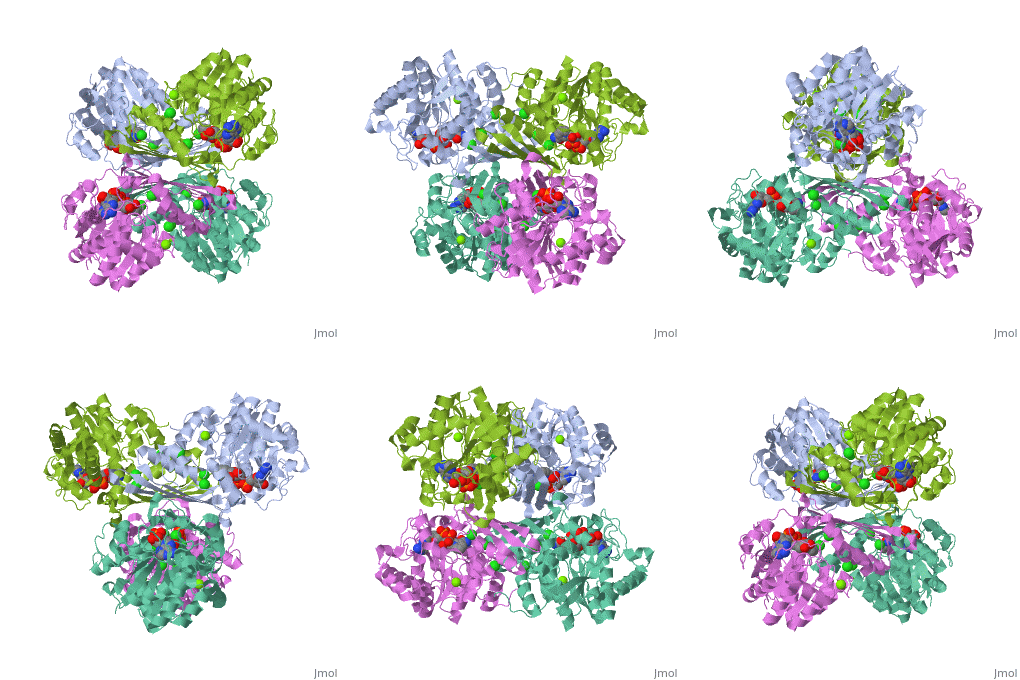

Hsp90 (90 kDa heat-shock protein) is one of a group of molecular chaperones responsible for managing protein folding and quality control in the crowded environment of the cell [1]. Although Hsp90 is involved in the triage of misfolded proteins under stress, it also plays a key role under normal conditions in regulating the stability and activation state of a range of ‘client’ proteins, many of which are critical for signal transduction [2]. As an extension of its protein-stabilizing role, work in model organisms shows that Hsp90 acts as a buffer or capacitor of genetic variation in morphological evolution [3]. Furthermore, there is strong evidence that Hsp90 plays an important role in disease states, particularly in cancer, where the chaperoning of mutated and overexpressed oncoproteins is critical [4]. This has driven the development of Hsp90 inhibitors for cancer treatment and, potentially, other diseases [5]. Recent systems-biology studies indicate that Hsp90 is a major interaction node, regulating a very diverse set of cellular functions [6,7]
