We apologize for Proteopedia being slow to respond. For the past two years, a new implementation of Proteopedia has been being built. Soon, it will replace this 18-year old system. All existing content will be moved to the new system at a date that will be announced here.

Main Page

From Proteopedia

Revision as of 12:39, 18 October 2018 by Jaime Prilusky (Talk | contribs)
Jump to: navigation, search

Because life has more than 2D, Proteopedia helps to understand relationships between structure and function. Proteopedia is a free, collaborative 3D-encyclopedia of proteins & other molecules. ISSN 2310-6301

Selected Pages Art on Science Journals Education
About this image
The ribosome

by Wayne Decatur
The 2009 Nobel Prize in Chemistry was awarded for studies of the ribosome. The ribosome is the machine in your cells that accurately and efficiently decodes the genetic information stored in your genome and synthesizes the corresponding polypeptide chain one amino acid at a time in the process of translation. These structures are considered landmarks for the fact they showed clearly the major contributions to decoding and peptide bond synthesis come from RNA and not protein, as well as for the sheer size of the structures determined.

>>> Visit this page >>>

About this image
Opening a Gate to Human Health

by Alice Clark (PDBe)
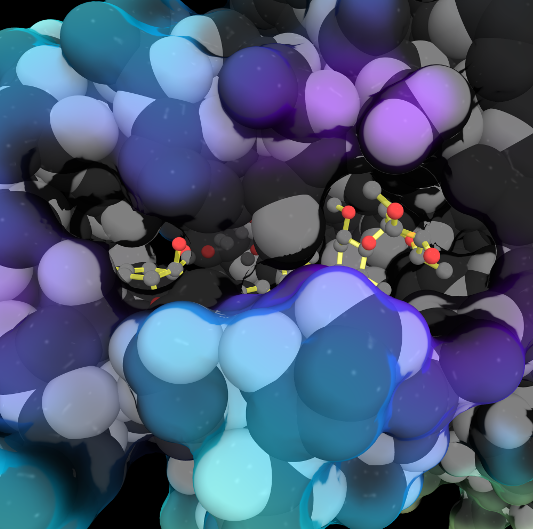
In the 1970s, an exciting discovery of a family of medicines was made by the Japanese scientist Satoshi Ōmura. One of these molecules, ivermectin, is shown in this artwork bound in the ligand binding pocket of the Farnesoid X receptor, a protein which helps regulate cholesterol in humans. This structure showed that ivermectin induced transcriptional activity of FXR and could be used to regulate metabolism.

>>> Visit this page >>>

About this image
Geobacter pili: surprising function.

Y Gu, V Srikanth, AI Salazar-Morales, R Jain, JP O'Brien, SM Yi, RK Soni, FA Samatey, SE Yalcin, NS Malvankar. Nature 2021 doi: 10.1038/s41586-021-03857-w
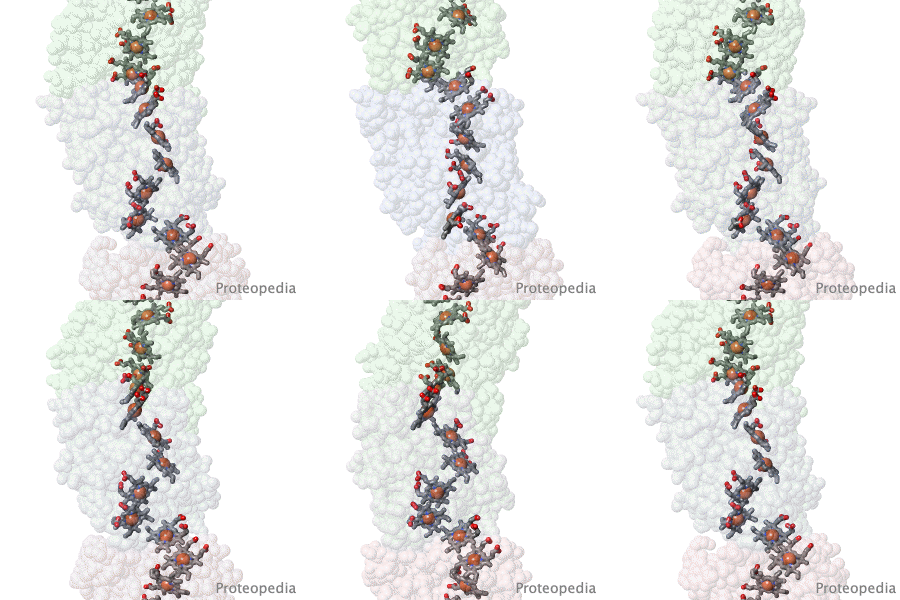
Geobacter pili were long thought to be electrically conductive protein nanowires composed of PilA-N. Nanowires are crucial to the energy metabolism of bacteria flourishing in oxygen-deprived environments. To everyone's surprise, in 2019, the long-studied nanowires were found to be linear polymers of multi-heme cytochromes, not pili. The first cryo-EM structure of pili (2021) reveals a filament made of dimers of PilA-N and PilA-C, shown. Electrical conductivity of pili is much lower than that of cytochrome nanowires. Evidence suggests that PilA-NC filaments are periplasmic pseudopili crucial for exporting cytochrome nanowires onto the cell surface, rather than the pili serving as nanowires themselves.

>>> Visit I3DC Interactive Visualizations >>>

About this image
Virus Capsid Geometry

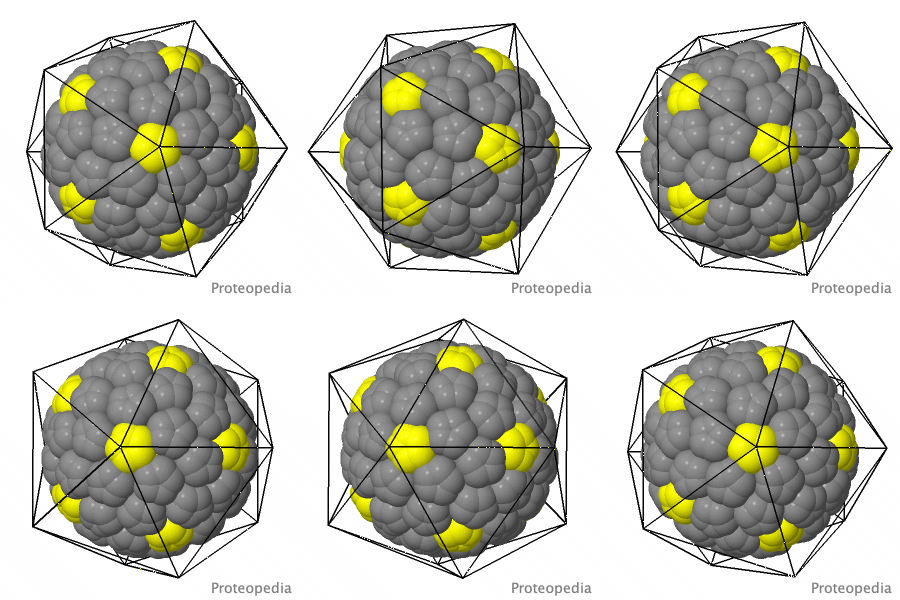
The Capsid of a virus is its outer shell or "skin". Viruses have evolved intricate and elegant ways to assemble capsid protein chains into complete, usually spherical capsids, often with icosahedral symmetry. Pictured is an extremely simplified model of a capsid, where a single enlarged atom represents each of the 360 protein chains in the capsid of the Simian Virus 40 (SV40), a member of a group of cancer-causing viruses that has been extensively researched for decades.

>>> See more animations and explanation >>>

Proteopedia Page Contributors and Editors (what is this?)

Joel L. Sussman, Jaime Prilusky

Personal tools