Main Page

From Proteopedia

Revision as of 14:54, 18 October 2018 by Jaime Prilusky (Talk | contribs)
Jump to: navigation, search
ISSN 2310-6301

Because life has more than 2D, Proteopedia helps to understand relationships between structure and function. Proteopedia is a free, collaborative 3D-encyclopedia of proteins & other molecules.


Selected Pages Art on Science Journals Education
About this image
HIV-1 protease

by David Canner
The X-ray structure of HIV-1 protease reveals that it is composed of two symmetrically related subunits which form a tunnel where they meet. This is critical because it contains the active site of the protease, consisting on two Asp-Thr-Gly conserved sequences, making it a member of the aspartyl protease family. The two catalytic Asp's either interact with the incoming water or protonate the carbonyl to make the carbon more electrophilic for the incoming water.

>>> Visit this page >>>

About this image
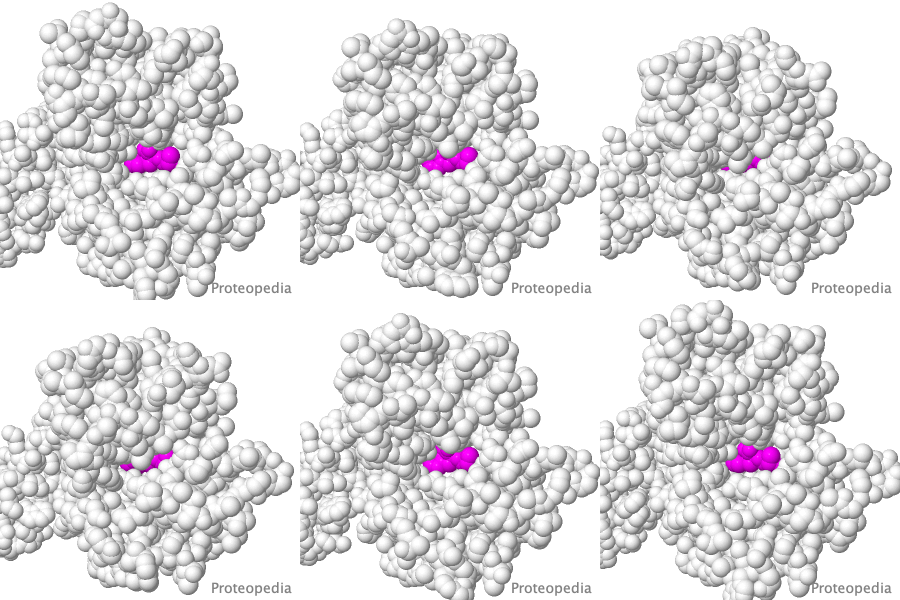
Opening a Gate to Human Health

by Alice Clark (PDBe)
In the 1970s, an exciting discovery of a family of medicines was made by the Japanese scientist Satoshi Ōmura. One of these molecules, ivermectin, is shown in this artwork bound in the ligand binding pocket of the Farnesoid X receptor, a protein which helps regulate cholesterol in humans. This structure showed that ivermectin induced transcriptional activity of FXR and could be used to regulate metabolism.

>>> Visit this page >>>

About this image
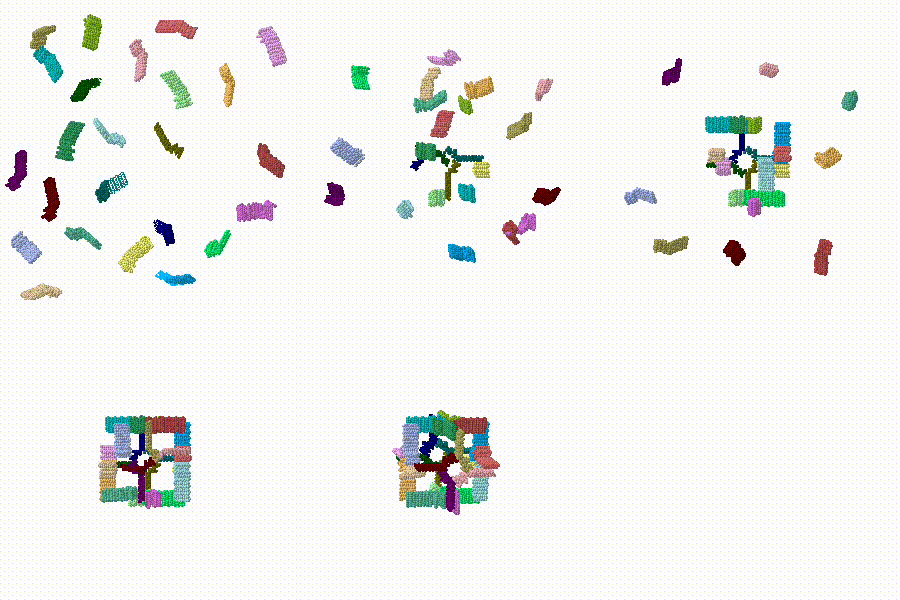
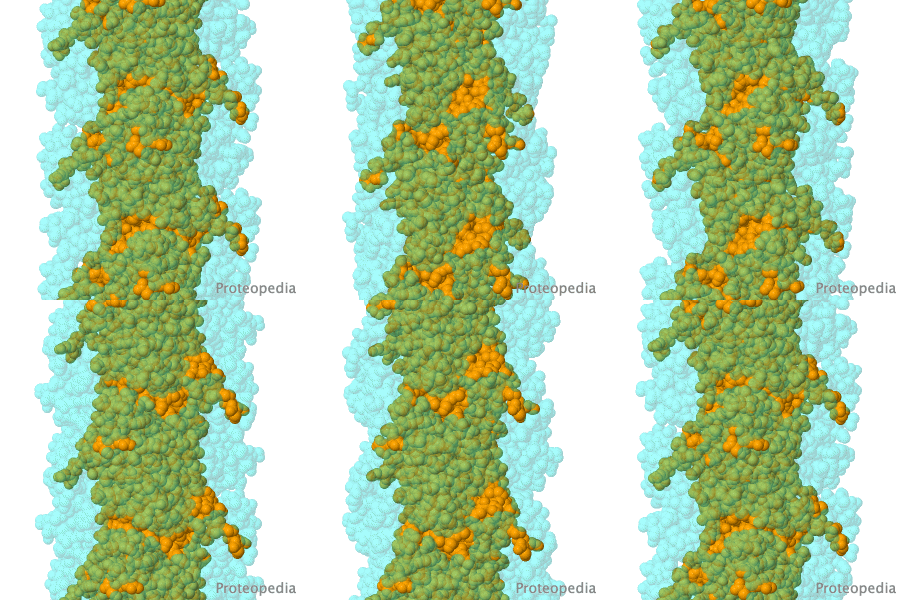
Geobacter pili: surprising function.

Y Gu, V Srikanth, AI Salazar-Morales, R Jain, JP O'Brien, SM Yi, RK Soni, FA Samatey, SE Yalcin, NS Malvankar. Nature 2021 doi: 10.1038/s41586-021-03857-w
Geobacter pili were long thought to be electrically conductive protein nanowires composed of PilA-N. Nanowires are crucial to the energy metabolism of bacteria flourishing in oxygen-deprived environments. To everyone's surprise, in 2019, the long-studied nanowires were found to be linear polymers of multi-heme cytochromes, not pili. The first cryo-EM structure of pili (2021) reveals a filament made of dimers of PilA-N and PilA-C, shown. Electrical conductivity of pili is much lower than that of cytochrome nanowires. Evidence suggests that PilA-NC filaments are periplasmic pseudopili crucial for exporting cytochrome nanowires onto the cell surface, rather than the pili serving as nanowires themselves.

>>> Visit I3DC Interactive Visualizations >>>

About this image
Make Your Own Electrostatic Potential Maps

Positive (+) and Negative (-) charges on the surface of a protein molecule play crucial roles in its interactions with other molecules, and hence in its functions. Electrostatic potential maps coloring the surface of a protein molecule are a popular way to visualize the distribution of surface charges. Easy to use free software is available to to create these surface maps. Above is an integral membrane potassium channel protein. One of its 4 identical chains is removed so you can see the Negative (-) protein surface contacting the 3 K+ ions.

>>> See Examples and Get Instructions >>>

Other Selected Pages Featured in Art Featured in I3DC Featured in Education

How to author pages and contribute to Proteopedia

Video Guides

Who knows ...

All Art on Science

How to get an Interactive 3D Complement for your paper

List of Interactive Complements

About Interactive 3D Complements

Teaching Strategies Using Proteopedia

Examples of Pages for Teaching

How to author pages and contribute to Proteopedia

About Image:Contact-email.png Table of Contents Structure Index Help

Proteopedia Page Contributors and Editors (what is this?)

Joel L. Sussman, Jaime Prilusky

Personal tools